

Interactive Exchange Between Science and Practice
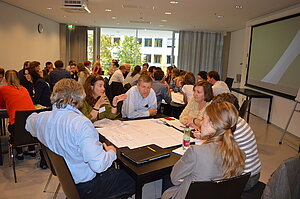
In September 2017, 280 people from science and practice met for the first time in Salzburg at the Unipark Nonntal to discuss new ways of addressing climate change and climate protection, and to motivate and inspire people to take action. The conference in Salzburg marked the launch of this biennial format in the D-A-CH region. In 2019, the congress moved to Karlsruhe for its second edition with nearly 500 participants, and in 2022 it headed to Zurich for its third. The K3-Kongress aims to get people moving on climate action by exploring the question of effective climate communication. It provides an overview of the international state of research on climate communication and makes new findings from research accessible and useful. At the heart of it all is the networking and exchange between actors from the fields of science, politics, public administration and business, interest groups, NGOs, as well as media and PR.
The most recent K3-Kongress took place from 25 to 26 September 2025 in Austria!
All the info about the K3-Kongress and the option to sign up for the newsletter can be found on the K3 website. You'll also find video recordings of the keynotes and a number of other talks there.
Feel free to follow our activities on social media too: Instagram, LinkedIn or Mastodon.
The organisers of K3, alongside CCCA as the Austrian partner, are the German partners: Deutsches Klima-Konsortium e.V. (DKK) and klimafakten.de, as well as the Swiss partners: National Centre for Climate Services NCCS and ProClim.
K3 Prize for Climate Communication
For the first time in 2021, a prize for climate communication worth a total of €15,000 was announced. The K3 Prize for Climate Communication is intended to recognise people, initiatives, and projects from the German-speaking world that have succeeded in delivering "good climate communication" in a particularly outstanding way — that is, communication about climate and climate change that is both scientifically sound and breaks new ground in motivating and inspiring people to take action on climate protection. The K3 Prize is awarded annually. In 2023, the award ceremony took place at the Museum für Kommunikation (MfK) in Frankfurt/Main. More details about previous prize winners and the K3 Prize can be found here.