

International coordination and comprehensive national implementation plans for climate action are essential to slow down global climate change, mitigate its impacts, and shape a sustainable future for young and future generations. Against this backdrop, the Federal Ministry for Climate Protection, Environment, Energy, Mobility, Innovation and Technology (BMK), following the involvement of the relevant other Austrian federal ministries, presented the draft integrated national energy and climate plan (NEKP) for Austria (period 2021–2030) at the end of June 2023. This draft was open for comment during the summer of 2023 to ensure broad participation from public and private institutions and individuals. We welcome this participatory approach, which can contribute to effective and widely accepted climate policy.
As part of the project "National Energy and Climate Plan (NEKP) for Austria – Scientific Assessment of the Measures Proposed in the 2023 Consultation", a team from the wider scientific community coordinated by the Climate Change Centre Austria (CCCA) is engaged in evaluating the measures proposed during the public consultation on the NEKP.
The aim of the project was to estimate and contextualise the potential of additional measures for greenhouse gas reduction with respect to the year 2030 that are not yet included in the NEKP draft – quantitatively represented in the With Existing Measures (WEM) and, in particular, With Additional Measures (WAM) scenarios of the Umweltbundesamt (UBA).
Whilst assessing the NEKP itself was not an objective, brief references to the NEKP are nonetheless made in several places – for example, that the quantitative estimates it contains for certain areas should be regarded as optimistic, or that the significance of certain indirect measures has not yet been sufficiently acknowledged – but only in each case to explain why a measure proposed in the submissions is afforded greater importance.
The measures gathered from the submitted statements were thematically assigned to the following areas: (i) transport, spatial planning and urban development, (ii) energy, industry and infrastructure, (iii) buildings, (iv) agriculture and forestry, land use change and bioeconomy, and (v) waste and circular economy, as well as the cross-cutting areas of (vi) biodiversity, (vii) governance and law, (viii) health, (ix) adaptation, (x) research & education, and (xi) competitiveness & innovation.
From the perspective of the cross-cutting areas, not only were the measures directly assigned to them evaluated, but these areas also provided commentary on the measures assessed as priorities in the other areas, in order to add their respective perspectives. This gave rise to intense interactions in the assessments, for example between agriculture/land use and biodiversity.
The order and length of the individual area chapters chosen in the report do not reflect the relevance of the subject areas.
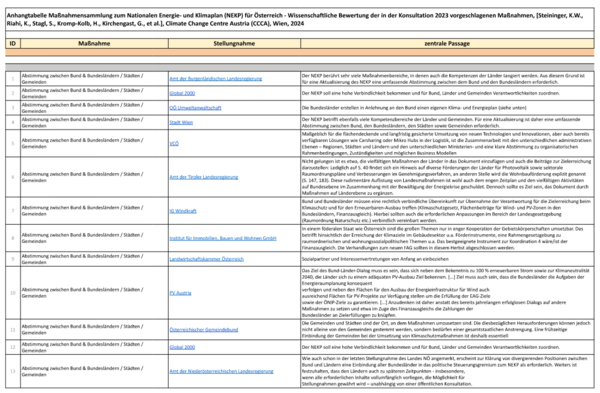
100 submissions made in response to the NEKP draft were evaluated. Broken down by submitting body, 15 submissions came from private individuals, 22 from NGOs, 10 from territorial authorities, 27 from interest groups, 15 from companies, 4 from scientific institutions and 7 from the category Other. In total, 1,408 proposed measures were recorded from the submissions, including duplicate entries and similar proposed measures. 355 measures were assigned to the area of transport, spatial planning and urban development, 337 to energy, industry and infrastructure, 151 to buildings, 93 to agriculture and forestry, land use change and bioeconomy, and 35 to waste & circular economy. In the cross-cutting areas, health had 15 dedicated measures, research & education 73, competitiveness & innovation 42, and governance & law 366. No dedicated measures were assigned to adaptation and biodiversity; a large number of comments from the biodiversity area can be found under measures in the main areas of land and energy, as there is significant overlap here. Since some measures were included in more than one area or cluster, the sum of measures across the areas is greater than the total number of measures received.