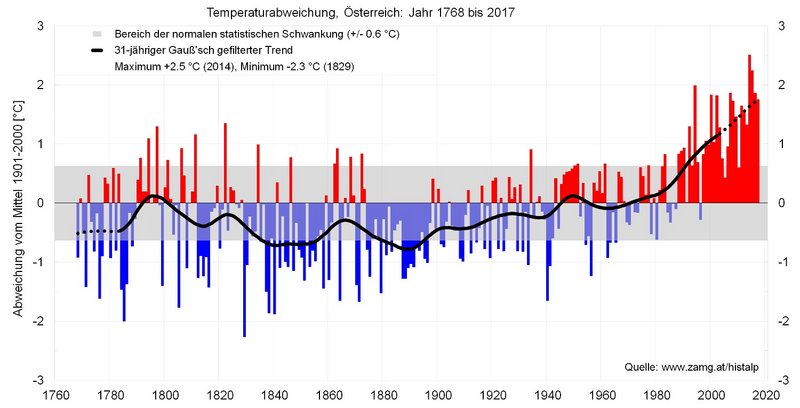


The year 2017 was warmer than average (0.9 °C above the long-term mean) and sunnier than average (11 per cent above the mean). Precipitation across Austria was pretty much in line with an average year.
2017 at a glance
2017 was also shaped by global warming and ranks among the warmest years in 250 years of measurement history. "According to initial analyses, 2017 was 0.9 °C above the long-term mean, making it the eighth warmest year since the start of the Austrian measurement series in 1768," says climatologist Alexander Orlik from the Central Institute for Meteorology and Geodynamics (ZAMG).
At the top of the warmest years, by a considerable margin, are 2014 (+1.7 °C above the long-term mean), 2015 (+1.4 °C) and 1994 (+1.2 °C). These are followed by 2016, 2007, 2002 and 2000 (all +1.0 °C above the mean), closely followed by 2017 (+0.9 °C above the mean).
Individual records
2017 started with one of the coldest Januaries in 30 years. However, many very warm months followed, including the warmest March and the second warmest June in measurement history. The summer ranked third in the list of hottest summers on record and brought an exceptionally high number of so-called heat days (at least 30 °C) as well as individual local records. For example, Andau in the Seewinkel region reached exactly the record of 47 heat days set in 2003. Hohenau an der March surpassed its station record with 47 heat days (previously 45 in 2012). Wolkersdorf and Zwerndorf also set new records for their respective locations (45 heat days in 2017, previously 44 in 2015).
Partly dry, partly wet
Precipitation in 2017 was 2 per cent below the mean in the Austria-wide analysis, putting it pretty much in line with an average year. "The regional breakdown is far more telling here, as rain and snow were — as is so often the case — distributed very unevenly across different regions," explains ZAMG climatologist Orlik. "2017 brought up to 30 per cent more precipitation, and in isolated cases even slightly more, mostly along the northern side of the Alps, from Vorarlberg to the Mostviertel region, as well as in Carinthia and Upper Styria. By contrast, conditions were around 10 to 25 per cent too dry, particularly along the Danube and to the north of it, as well as in the Vienna Basin, Burgenland and the south of Styria."
One of the ten sunniest years since 1925
In the Austria-wide analysis, 2017 brought 11 per cent more sunshine hours than an average year. This places it among the ten sunniest years since the start of comprehensive sunshine duration measurements across Austria in 1925.
Text first published on <link http: zamg.ac.at>zamg.ac.at
<link https: www.zamg.ac.at cms de klima news achtwaermstes-jahr-der-messgeschichte external link in new>To the ZAMG's preliminary climate review for 2017