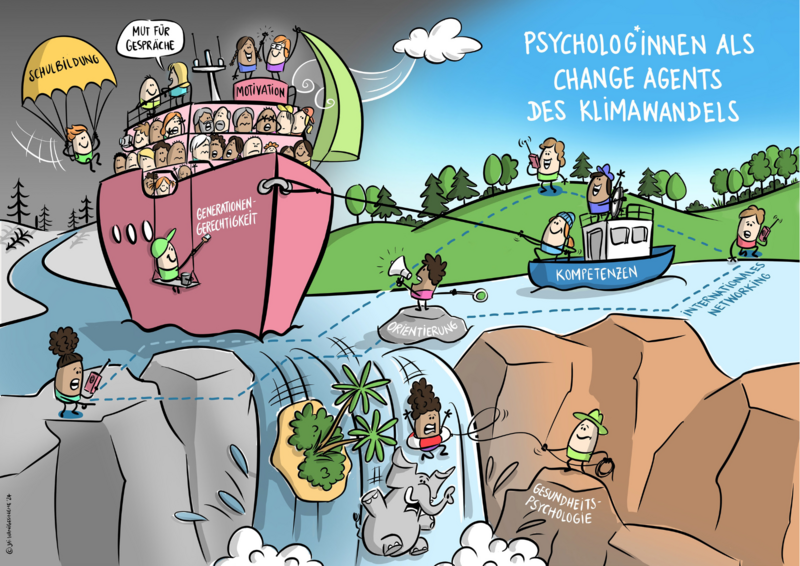


The healthcare system needs to be further developed to better address not only the physical but also the psychological impacts of climate change. A "national resilience plan" is needed to work out how people can deal with the stress of climate change as "productively" as possible. These are the demands put forward by psychologists in the recently published national climate resilience plan.
Just in time for the COP29 UN Climate Conference 2024 in November in Baku, the German Professional Association of Psychologists (Berufsverband Deutscher Psychologinnen und Psychologen) has published its 2024 climate report "Psychological Perspectives on Climate Change: Strategies and Concepts".
In recent years, the climate crisis has intensified, and massive conflicts of interest — particularly in dealing with high-emission sectors — are delaying the necessary climate protection measures at the political level, especially in Germany. At the same time, governments around the world have begun to respond to the consequences of climate change and to adapt policy decisions in favour of a more climate-friendly transformation. One thing is clear: if we want to make Germany fit for the future in terms of greater sustainability as well as as an economic hub, it's high time to act. Broad public support is essential — as this issue is also fundamentally about fairness and social cohesion.
With a wide-ranging repertoire of scientifically grounded and proven strategies and methods, psychology in particular can make a central contribution — through its professional expertise — to tackling the climate crisis and its consequences.
"The psychological perspective is indispensable for addressing the challenges of climate change and encouraging people's motivation to take action. Only through a deep understanding of human psychology can we achieve long-term changes that benefit both the environment and society," explains BDP President Thordis Bethlehem.
But how can we reach people and trigger behavioural change? How much responsibility do individuals bear, and where does the responsibility lie with policymakers? What might positive climate communication look like, and how do we develop climate resilience in dealing with the direct consequences, as well as with regard to the necessary transformation towards greater climate neutrality?
The BDP report focuses on these key issues in the context of climate change, sheds light on the impacts on mental health, and addresses intergenerational justice. It outlines the most pressing areas for action, formulates concrete recommendations, and builds a bridge towards political dialogue and the necessary cooperation at the international level.
As a tangible outcome of international networking, the report includes the 10-point paper on promoting climate action from the European Federation of Psychologists' Associations (EFPA), of which the BDP is also a member. Also included are the Climate Action Framework and Action Plan of the Global Psychology Alliance, a worldwide network of more than 70 psychologists' organisations.
As a professional association, the BDP has been engaged in the political debate on climate change for many years, whilst also fulfilling its social responsibility as a psychology association to promote climate protection. It is time to set the course for a more climate-neutral future at the political and societal level. The psychological perspective on climate change can help society as a whole to kick-start the necessary measures right now.
All information available at: www.bdp-verband.de