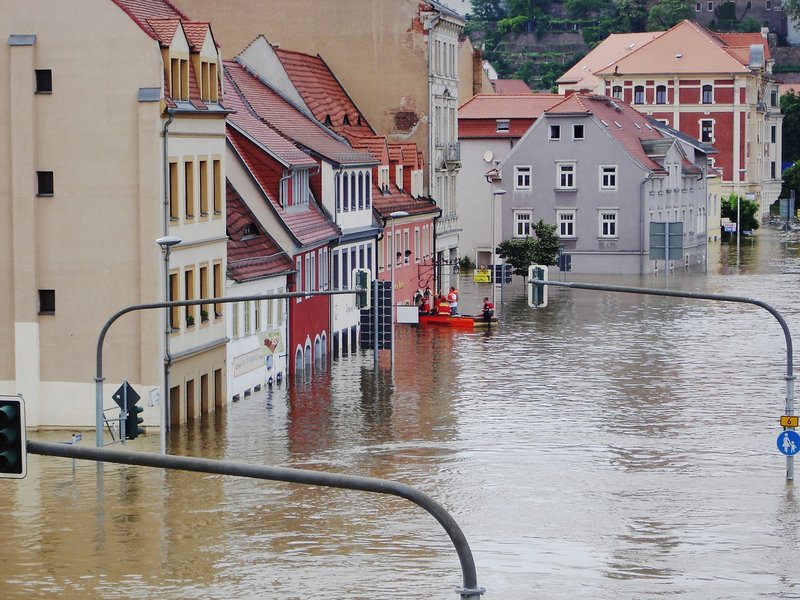


Over the past few days, numerous and at times contradictory pieces of information about the extreme weather event at the weekend and its connection to climate change have been circulating across various (social) media channels. Together with experts from the CCCA network, including Herbert Formayer from BOKU University, Douglas Maraun from the University of Graz, and Marc Olefs from GeoSphere Austria, we've worked to provide a clear and accessible assessment.
For over 30 years, climate research has been publicly warning that human-caused climate change is intensifying extreme weather events such as heatwaves, droughts, and severe storms, and making them more frequent in Austria too. Following the simple principle of "climate change PLUS unfavourable weather patterns = faster escalation", climate change is causing extreme weather events — such as the heavy rainfall of recent days — to be exceptionally intense. This principle will continue to hold in the future. We need to prepare for more frequent and more intense storms, longer heatwaves, and heavier precipitation — to which climate change is making a decisive contribution. Recent events make the urgency of climate protection and climate change adaptation (e.g. flood protection, rewilding) all the more apparent.
Heavy rainfall last weekend
Over the past few days, Austria, Poland, and the Czech Republic in particular experienced severe heavy rainfall events, caused by an unusual weather constellation (a slowly moving Vb low-pressure system within a blocking weather pattern associated with a cut-off upper-level low). While such weather events are rare, they're not unheard of — what stands out are the extraordinary amounts of rainfall. We know that climate change is making heavy precipitation more frequent and, in particular, more intense. The unusually warm, moisture-laden air from the Mediterranean region collided with very cold Arctic air, leading to the formation of intense precipitation. The Mediterranean is currently exceptionally warm, which allows air from that region to absorb more water vapour. This moisture was released in the form of heavy rainfall and, at higher altitudes, led to extreme snowfall. Weather services had also accurately forecast the situation in advance.
In Austria, the combination of these factors had severe consequences. The weather system remained close to the Eastern Alpine region for several days, exacerbating flooding and mudslides. This prolonged persistence — as a possible expression of the climate crisis — is currently a subject of ongoing research. There is a suspicion that, in addition to the enormous amounts of rainfall, soils dried out by last summer's heat may also have contributed to an insufficient absorption of the large volumes of water.
In the worst-affected areas of the federal state of Lower Austria, rainfall over 5 days was between 120 and 160 per cent higher than during comparable extreme events since 1961. In the coming weeks and months, attribution studies will be carried out by experts in international scientific collaboration to examine more closely the causes of the extreme rainfall amounts seen in recent days.
Ongoing climate change intensifies extreme weather events
A central finding of the latest global climate report is that human-caused climate change is already intensifying the severity of extreme weather events. If climate change continues at its current pace, these intensities will increase further. The enormous greenhouse gas emissions that humans have been releasing into the atmosphere since industrialisation are the primary driver of the rapid rise in air and ocean temperatures. In addition, air quality measures have contributed to increased solar radiation reaching the Earth's and ocean surfaces, further accelerating warming. Having been at least partially masked for decades by rising air pollution from industrialisation, the full extent of climate change has been becoming increasingly apparent since the mid-1980s.
Action is needed
In order to better cope with extreme weather events in the future, targeted measures for climate change adaptation are essential. Alongside concrete measures such as protecting unsealed soils and improving existing protective infrastructure, structural steps and awareness-raising measures are also crucial. Rapid implementation requires adequate funding, as well as appropriate institutions and legislation. These adaptation measures are just as necessary as reducing global greenhouse gas emissions to net zero, so as not to exceed the limits of adaptation. Austria, too, must play its part in halting global warming and preventing a further increase in catastrophic impacts. The longer action is delayed, the harder it will become to avert the worst effects, as protective measures alone will not suffice or will reach their limits. The aim is to make our infrastructure and our behaviour more resilient, and to harness nature — in the spirit of "nature-based solutions" — as part of the solution. It is therefore important that, in addition to technological solutions, we also adapt our way of life and our relationship with nature. Only through a balanced interplay of technology and environmentally conscious behaviour can we sustainably manage the impacts of climate change.
Further information on the specific weather situation: https://www.zamg.ac.at/cms/de/klima/news/deutlich-mehr-regen-als-bei-frueheren-extremereignissen
CCCA press release 13.09.2024: Extreme precipitation forecast – growing threat from extreme weather: climate change and soil sealing increase flood risk
CCCA Fact Sheets on land use and flooding:
#39 Land use in Austria
#27 The involvement of citizen groups in flood risk management: new roles and responsibilities in climate change adaptation
#18 Climate change adaptation for private households: self-protection against flood risks
#9 Impacts of climate change on flood hazards from rivers in Austria