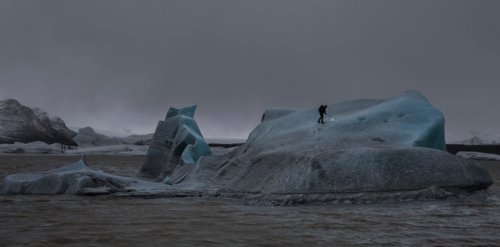


Even before Corona brought the cultural sector to a standstill, a rethink had already begun: how can the cultural sector, with its many international events, be made more climate-friendly? It's a question that's on the minds of many major artists. Yet artistic actions and engagements with climate change are quite controversial. Critics describe climate art as hypocritical, arguing that it pollutes the world itself.
It's not just major writers like Jonathan Safran Foer and Jonathan Franzen who are grappling with climate change — visual artists are also sounding the alarm time and again: Olafur Eliasson had Greenlandic blocks of ice melt in front of the Tate Gallery of Modern Art in London to draw attention to the environment. His former students Julius von Bismarck and Julian Charrière also explore the explosive relationship between nature and humanity in their art.
The international art world is an unparalleled CO2 machine
The Golden Lion at the last Venice Art Biennale was won by a climate opera from Lithuania. However, many performers flew in by plane for the critical performance about global tourism and environmental indifference. The international art world in particular, with its biennales and fairs, is an unparalleled CO2 machine. Even if the world is currently at a temporary standstill due to the pandemic, the carousel will soon start spinning again — and then what?
Should cultural practitioners hold up a mirror to people and shake them out of their complacency? Or rather reduce their own carbon footprint, as choreographer Jérôme Bel has been demonstrating for years? At Bel's performance company, there's a strict no-flying policy. He rehearses his choreographies with his dancers via Skype — and accepts artistic compromises in return. Until the outbreak of Corona, he was an exception in the cultural sector. The pandemic, however, forced many others to follow his lead.
Environmental certification for the arts?
Last year, major museums also recognised the signs of the times. The Tate Gallery declared a climate emergency and wants to cut its CO2 emissions by 10 per cent by 2023. Austria began developing an environmental certificate for museums. And London's Serpentine Gallery has appointed a curator for sustainability: Lucia Pietroiusti. She's tasked with advancing environmental compatibility through collaborative projects across the industry.
So things are moving, but how forward-looking are these approaches really? Wouldn't it be far more effective to put the brakes on the global travelling circus of biennales, festivals, and fairs? And can the cultural sector learn something from the pandemic about how to deal with climate change?
In the film by Frauke Schlieckau, artists, gallerists, authors, and cultural practitioners discuss these questions. Featuring: Julius von Bismarck, Julian Charrière, Rugilè Bardziukaitè, Lina Lapelytè. Harald Welzer, Jonathan Safran Foer, Tino Seghal, Jérôme Bel, Andreas Greiner, André Schlechtriem, and Frédéric Schwilden.
Available until 26/06/2021!