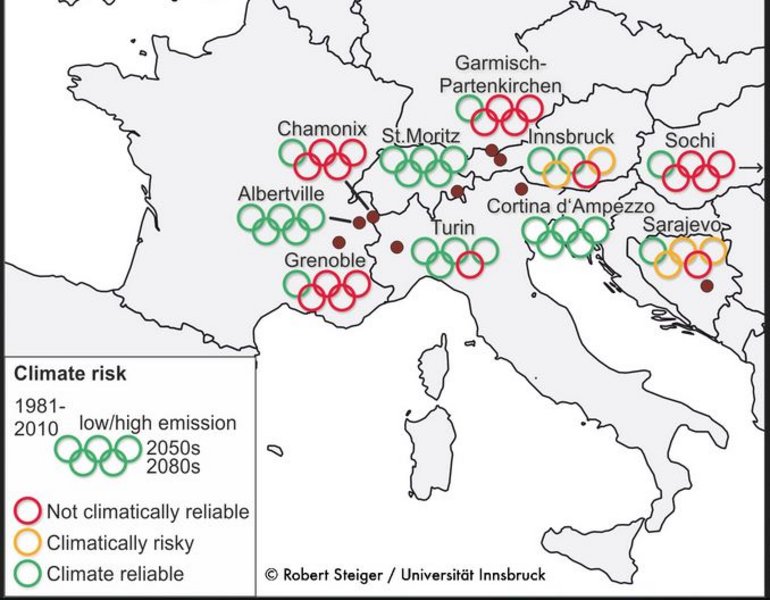


If global greenhouse gas emissions aren't drastically reduced, by the end of this century only 8 of the 21 previous Winter Olympics host venues will be cold enough to host the Games again – the two-time Olympic city of Innsbruck would then barely be able to stage Winter Games. This is what a study shows, in which tourism researcher Robert Steiger from the University of Innsbruck was involved.
"The conditions for winter sports are changing. This also affects elite sport, which is increasingly being impacted by climate change at both training and competition venues", says co-author Robert Steiger, Assistant Professor at the Institute of Public Finance. "The climate in many traditional winter sports regions is no longer what it once was, and fewer and fewer places will be able to host the Winter Olympics in the future if global warming continues to increase."
Sochi as a cautionary tale
"There are limits to what current strategies for mitigating weather impacts at major events can achieve, and at the last Winter Olympics we saw those limits being exceeded", added lead researcher Daniel Scott, Professor of Geography and Environmental Management at the University of Waterloo in Canada. "We had predicted at the time that the weather and snow conditions at the 2014 Games in Sochi would be a challenge. Predictions that proved accurate, as the number of cancelled training sessions and athletes' complaints about variable and unpredictable conditions demonstrated."
If the commitments to reducing greenhouse gas emissions under the Paris Climate Agreement are met, 12 of the 21 previous host venues could still stage Winter Games in the future. Former hosts such as Squaw Valley in the USA, Vancouver in Canada, and Sochi in Russia would fall off the list. "Climate change is reshaping the geography of the Winter Olympics", says Robert Steiger from the University of Innsbruck. "The decisions of the International Olympic Committee on awarding the Games will become increasingly difficult. And some regions would be better off applying sooner rather than later if they want to host future Winter Games."
Adaptation measures are becoming more demanding
The need for risk management strategies such as snowmaking, ice and ski jump cooling, and high-resolution weather forecasting has grown at Winter Games venues, as average daily temperatures in February continue to rise. The average temperature has increased from 0.4 °C at venues from the 1920s to 1950s, to 3.1 °C at venues from the 1960s to 1990s, and to 7.8 °C at Winter Olympics in the 21st century, partly because the Games have increasingly been awarded to warmer regions. This risk management will become even more important in the coming decades, as average February temperatures at previous host venues are projected to rise by a further 1.9 to 2.1 °C by mid-century and by 2.7 to 4.4 °C by the end of this century.
The 2018 Winter Games in Pyeongchang, South Korea, and 2022 in Beijing, China, are reversing the trend of hosting the Winter Olympics in ever warmer regions, however. "Given the strong growth of winter sports in China, it was fascinating to see that the Games in Beijing, with the mountain regions of Yanqing and Zhangjiakou, have a very stable future even under very warm climate scenarios", says Yan Fang from Peking University in China.
<link https: www.uibk.ac.at newsroom olympia-unter-druck.html.de external-link-new-window internal link in current>The text of this press release was first published on the University of Innsbruck's website.