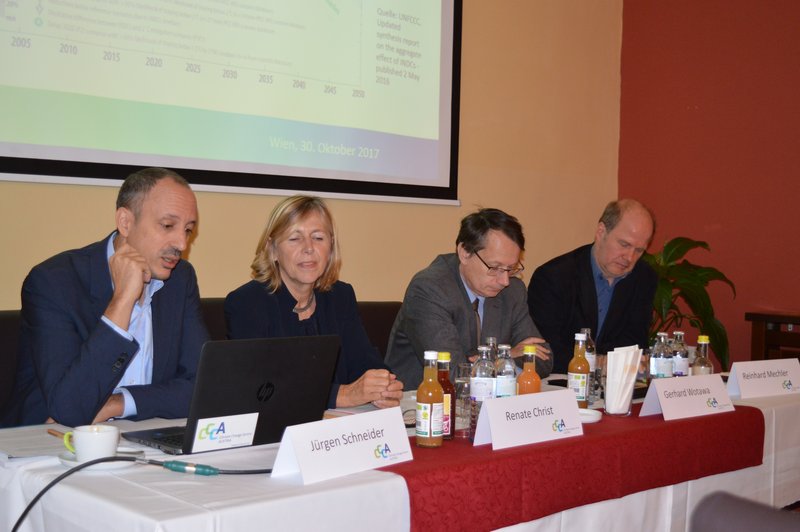


On 30/10/17, the following appeal by CCCA was presented to the press:
"Climate Policy in Austria: It's Time!
Researchers from the Climate Change Centre Austria (CCCA) are appealing, at the start of the 23rd international climate negotiations in Bonn, to domestic policymakers to push forward the necessary measures on climate protection, adaptation and financing, and to embed these as a central, cross-departmental issue in the coalition agreement currently being negotiated.
2014, 2015, 1994, 2016, 2007 — these are the warmest years recorded in Austria's 250-year measurement history. Four of these five years are from the last decade — the climate is changing, globally and in Austria, with serious consequences. Globally, the years 2015 and 2016 brought new record highs of carbon dioxide (CO2) in the atmosphere as well as new temperature records, a steadily rising sea level, and a worsening of extreme weather events such as droughts and hurricanes.
In light of these facts, the Paris Agreement of December 2015 succeeded for the first time in negotiating an international treaty in which the community of nations committed to limiting global warming to well below 2°C (ideally 1.5°C). This treaty entered into legal force in November 2016 and requires the collective effort of all nations to reduce their emissions, drive forward adaptation, and support developing countries in their efforts. In parts of the world, including the Alpine region, the temperature increase has already reached or exceeded the 2-degree mark compared to pre-industrial levels, which underlines the urgency. Achieving the goals of the Paris Agreement requires largely phasing out the use of fossil energy by the middle of the century.
Five to midnight was yesterday
Since the plans put forward so far by the international community are collectively insufficient to curb climate warming adequately, these must be continuously strengthened. From 1990 to 2015, there was no reduction in greenhouse gas emissions in Austria — during the same period, EU emissions fell by 20%. Austria will be legally obliged under EU law to reduce its greenhouse gas emissions outside the emissions trading system by 36% compared to 2005 levels by 2030. At present, there is no strategy in place for how this target can be achieved or how the phase-out of fossil energy use can be accomplished by the middle of the century.
Although Austria has ratified the Paris Agreement, the measures taken so far do not cover the necessary and expected contribution towards achieving the global 2°C target, let alone the 1.5°C target.
The impacts of climate change already being felt — whether in agriculture and forestry, the health consequences of heat stress, or winter tourism — require numerous and in some cases very costly adaptation measures. These must go hand in hand with an emissions reduction strategy in order to avoid even more costly adaptation and the exceeding of adaptation limits in Austria and particularly vulnerable countries in the Global South, whilst simultaneously managing the unavoidable consequences of climate change.
Boldly into the new era
The current government formation process in Austria offers the opportunity to set new priorities and make climate and energy policy a national priority. A cross-departmental, integrative and constructive climate policy also contributes to addressing other current challenges, such as meeting the UN Sustainable Development Goals.
Measures such as an ecological and social tax reform, a recalibration of the Energy Efficiency Act, the transition of heat supply to renewable energy and waste heat, the creation of economic incentives to switch to climate-friendly modes of transport, the establishment of substantial strategic investment projects in the production sector, and the creation of a strong research strand for climate change and societal transformation are long overdue! Under the umbrella of the climate research network Climate Change Centre Austria (CCCA), the research institutions active in Austria on climate change are offering their knowledge and solution-oriented concepts to work together with policymakers, society and industry on developing a sustainable and successful vision for our future.
The experts of CCCA are appealing to politicians of all parties to swiftly take the long-overdue decisions that are of lasting importance for Austria. Decisions that can turn the greatest challenge currently facing society — and in the decades ahead — the question of how we can preserve our planet as a liveable habitat for all people, into an opportunity for development towards a more sustainable and economically prosperous Austria. The ambition should be to make Austria a frontrunner in climate protection and climate change adaptation."
Press coverage:
- <link https: kurier.at chronik oesterreich klimawandel-experten-appell-an-kuenftige-regierung external-link-new-window external link in new>Climate change: Experts' appeal to the future government (kurier.at, 31/10/17)
- <link https: science.apa.at site natur_und_technik external-link-new-window external link in new>Climate change — Experts' appeal to the future federal government (APA Science, 31/10/17)
- <link https: www.news.at a klimawandel-experten-appell-an-kuenftige-bundesregierung-8400869 external-link-new-window external link in new>Climate change — Experts' appeal to the future federal government (news.at, 31/10/17)
- <link http: oe1.orf.at player external-link-new-window external link in new>Ö1 Morgenjournal with Gerhard Wotawa, 06/11/17: "Climate conference: Fiji on the brink"
- <link http: derstandard.at un-klimakonferenz-soll-weichen-stellen external-link-new-window external link in new>Climate change from 2030 as costly as a major tax reform every year (DerStandard, 06/11/17)