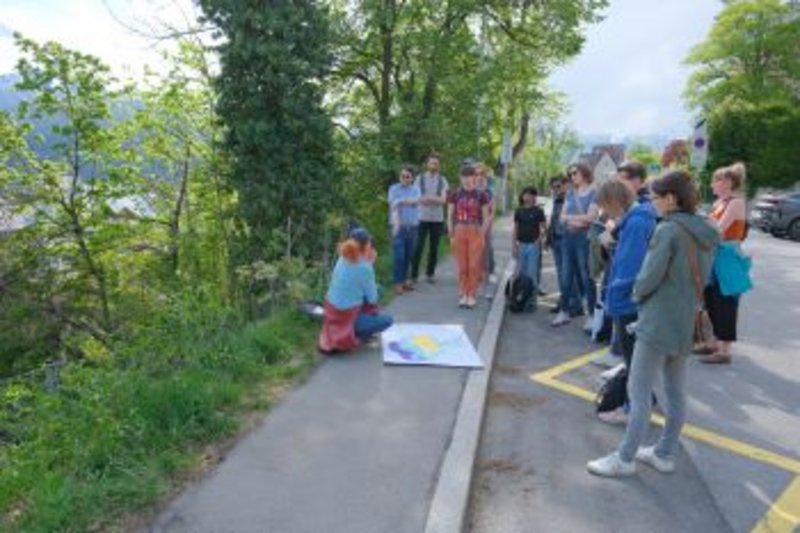


Climate Walks are a transdisciplinary method for supporting the transformation of cities, municipalities, and regions. Science and practice come together to jointly experience challenges (e.g. heat stress) and good practices (e.g. shared spaces and climate-resilient places), to develop new action knowledge and evidence-based yet practically applicable solutions in the areas of climate protection, climate change adaptation, and climate justice, and to move into action.
As part of the Austrian Climate Day 2025, two Climate Walks under the title "Alpine-Urban" took place in Innsbruck on 23 April. Both explored the influence of climate change on urban and alpine spaces, as well as possible adaptation strategies and measures.
The first route led from cool-INN through the Augarten and the old town to the Agnes Heller Haus and was introduced by Holger Hoff. Topics such as (non) climate-resilient spaces, the sponge city principle, and the necessary integration of various technical, ecological, economic, and social aspects across different municipal departments were presented using the cool-Inn example by Markus Pinter and Michael Trojer, and the Haus der Musik example by Christian Schoder. The involvement of society in science and climate discourse was also briefly addressed using the citizen science project CITREE as an example. In the old town, aspects such as traffic calming, sustainable mobility, and competition for space amid growing cycling traffic were also presented by Christian Schoder. At the Bruno Sander Haus, Thomas Karl provided insights into weather, climate, and pollutant measurements and observed trends.
The second route started in the Botanical Garden, where Sophie Hohenwarter and Eva-Maria Holzinger provided an introduction. Andrea Ganthaler explained the effects of climate change on vegetation, tree lines, and protective forests. Deniz Branke reported on the role of the Alpine Club in climate protection. With a view over Innsbruck, heat action plans, urban climate analyses, and the significance of alpine cold air flows were discussed, as explained by Christine Schermer. Dominik Neugebauer presented topics related to mobility and accessibility, while Klaus Schallhart presented flood protection measures along the Inn.
Climate Walks – Get Involved and Help Shape the Future!
Interested parties are warmly invited to organise their own Climate Walks or to contribute to the further development of the format. Contact: holger.hoff@uni-graz.at
Together, step by step towards a more sustainable future!