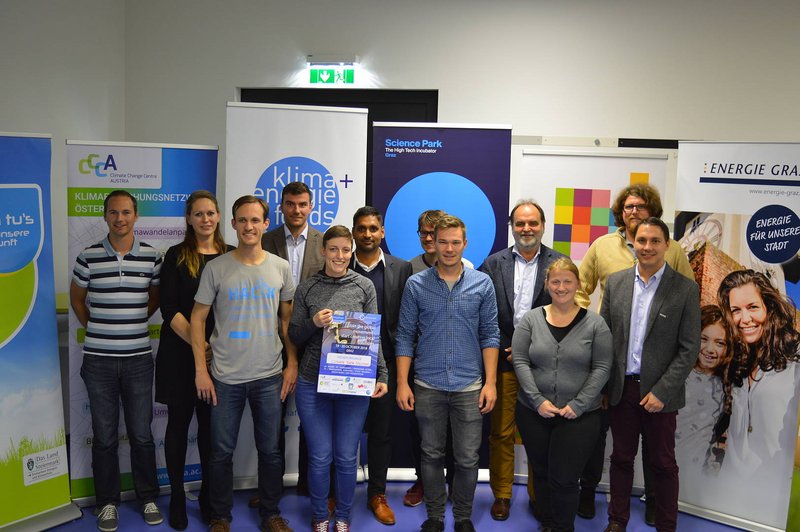


Here we go! The tables are set up, white sheets of paper, highlighters, scissors and Post-Its are all within easy reach. Drinks, nuts and chocolate are on hand to keep everyone's energy up. One by one, the first participants arrive at TU Graz's Science Park. They pull on T-shirts and glance around the room — a little shy, but clearly excited. Some already know each other and are catching up, while others are quietly taking it all in. Nobody quite knows what to expect. Everyone is here voluntarily and they all share one common goal: over the next few hours, they want to come up with creative and innovative ideas and turn them into solutions for the green city of the future.
The Climathon is not a new idea — this is already the fourth time that people in over 100 cities have come together to tackle the challenges of climate change. Officially, the 24-hour marathon is a "hackathon", but it's not just about coding or developing software products; above all, it's about finding innovative ideas, fresh perspectives and solutions for a more sustainable future. This year, Austria is hosting the Climathon for the very first time. In Graz and Vienna, however, it's taking place ahead of the official date due to the national holiday. Anyone can take part — all that matters is your own creativity.
The moment has arrived — the challenges are announced. The challenge sponsors have brought four different tasks for which participants are expected to develop concepts and solutions. The four challengers are the City of Graz, the State of Styria, Holding Graz and Energie Graz. They see the Climathon as an opportunity to find new ideas and perspectives for the future of mobility, public transport and photovoltaics.
Dominik Piringer and Wolfgang Götzhaber from the City of Graz's Environmental Office are the first challengers up. They want to make climate and air quality data more accessible to citizens, and are hoping for useful input from the participants.
The second challenge comes from the State of Styria and is presented by Adelheid Weiland. The key question is: how can the public contribute to a social transformation towards a climate-friendly transport system? It's a topic that sounds interesting to many of the teams.
Matthäus Hubmann from Energie Graz is hoping participants will come up with new ideas for using renewable energy more efficiently and reducing losses. The focus is particularly on energy storage. This challenge also raises the question of how to motivate residents to be more mindful about using renewable energy in their homes.
The last challenger to step forward is Martin Schmidt, representing Holding Graz/Mobility Labs. As public transport becomes increasingly important for cities, he poses the question of what an integrated public transport network could look like in the future.
The room falls quiet. The participants are well aware that a lot is expected of them. In just 24 hours, they're supposed to tackle problems that nobody has solved before — and possibly even implement them technically. "Now you can start the project!" Host Katrin breaks the silence and calls on the teams to get started on their chosen climate protection project. Chairs are pushed back, participants form groups and get to work.
Once they've found their spot, teams gather around tables in circles, and any shyness quickly gives way to a flood of ideas. Almost everyone already has a thought they want to share. Within minutes, the previously blank sheets of paper are covered in colourful writing and the walls are plastered with Post-Its. There's a real buzz in the air. Time to solve the challenges and deliver fresh impulses is tight. To keep things lively and everyone alert and focused, there are educational workshops, exercise sessions to ward off tiredness and tasty snacks dotted throughout the event. After all, the Climathon is not just about generating ideas — it's also there for networking, exchanging views and learning. Mentors and challenge sponsors are actively on hand, advising the groups well into the early hours of the morning.
The coffee machine hums away. It's already early morning and time for breakfast. You can see the tiredness on the participants' faces. Only a few of them managed to work through the entire night. Some slept at TU Graz, others went home to sleep and returned just a few minutes ago. Now, so close to the presentations, sleep is the last thing on anyone's mind. The nerves are palpable — time is nearly up.
For the "finale" of the hackathon, teams have just five minutes to present their concepts and proposed solutions to a jury made up of the challengers, coaches and a Climathon representative from Switzerland. After the pitch, they have another five minutes to answer questions from the audience. Prizes up for grabs include prize money, coaching sessions and the chance to develop their solutions and ideas further with the challenge sponsors. A great opportunity — and Bianca and Philipp, two participants who both care deeply about the environment, think so too. "We're just trying to put our ideas for reducing emissions in the future into practice and hope that it will actually make a difference down the line," says Philipp. Bianca adds: "And that it gets taken on board and implemented — by local politicians, for example."
Others have even more concrete visions. Thomas, Simon and Konstantin from Donau-Uni Krems have come up with an app for the State of Styria designed to motivate people to form carpools. Their idea is called "Ride2Park" — people would be rewarded with coffee and nice prizes for sharing their car with others. The three young men are enthusiastic about all the projects. "We scrapped our idea twice. But we're happy with what we've managed to pull off!" explains Thomas proudly, adding that he never would have thought so much could be achieved in such a short space of time.