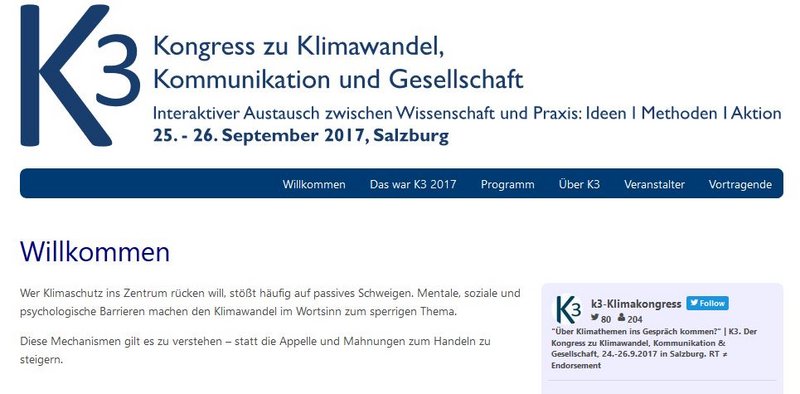


Two days, six scientific talks, 18 practical workshops, a multi-denominational morning devotion, a <link https: www.klimafakten.de meldung klima-meets-kultur-juri-de-marco-und-das-orchester-des-wandels-begeistern-k3 _blank>musical world première. 280 participants, more than 500 <link https: twitter.com hashtag _blank>tweets with the hashtag #k3klima, 400 Esterházy tartlets consumed at the catering buffets. This (and much more) was K3 — the first congress on climate change, communication and society, held on 25 and 26 September in Salzburg.
Over the coming days, we'll be publishing a few reports here on klimafakten.de from individual sessions at the conference. To wrap things up on Tuesday afternoon, six participants answered three questions about the event. On the panel (moderated by Carel Mohn, klimafakten.de) were: <link https: twitter.com _blank>Tatiana Herda Muñoz (climate protection manager for the City of Mainz and Vice Chair of the Federal Association for Climate Protection, BVKS), <link https: forschung.boku.ac.at fis _blank>Helga Kromp-Kolb (meteorologist and climate researcher at the University of Natural Resources and Life Sciences, Vienna), <link https: www.uni-oldenburg.de en torsten-grothmann _blank>Torsten Grothmann (psychologist at the University of Oldenburg), Mira Kapfinger (studying environmental resources management and <link https: k3konferenz.wordpress.com _blank>blogging from K3), Alina Ross (studying sociology in Frankfurt/Main) and Christiane Textor (<link http: www.de-ipcc.de _blank>German IPCC Coordination Office). We've documented some of their responses below.
What were your new insights, your "aha moments" at K3?
Alina Ross: A lot of what came up at the conference wasn't entirely new, but I still made a note of one key insight in big letters: "Facts alone aren't enough." It's not sufficient to simply convey scientific findings to people about climate change. You need to reach them in very different ways, depending on the target audience and their social milieu. When it comes to climate communication, you really have to think carefully about where you can meet people, and which of their interests you can tap into.
(Interjection from the audience: I found the image really compelling — that facts are the bones of a good story. On their own they're bare skeletons, but without them the story can't stand. We shouldn't swing from one extreme to the other now — facts alone are definitely not enough, but you can't do without them either!)
Christiane Textor: For the scientific community, it's certainly quite a new message that you don't need to talk quite so much about the facts any more. And that when giving a talk, you shouldn't start — as is customary among researchers — by explaining where the limits of knowledge lie and exactly how large the uncertainties in the findings still are...
<link https: twitter.com klimafakten status _blank>Susanne Moser's talk this morning has really stayed with me. She reminded us again just how urgent the transformation is. The change — not just of the climate, but of society too — it's coming! It's coming regardless. We can choose whether we want to help shape that change. And there's quite a knowledge gap here: many people out there don't even know yet that a transformation is on its way at all.
Mira Kapfinger: My aha moment was learning that <link https: www.klimafakten.de meldung wissenschaftlicher-konsens-ueber-klimawandel-97-prozent-oeffnet-das-tor-fuer-fakten _blank>the message of the 97 per cent consensus in climate research can act as a so-called gateway — when people understand this, it increases their openness to other information and their willingness to act. But of course, communicating only the consensus isn't enough.
I was also fascinated by the devotion with the seven denominations. I had heard at the time about <link https: www.klimafakten.de meldung die-energiewende-steht-schon-im-koran _blank>the 2015 appeal by Islamic scholars on climate change, but had long since forgotten about it.
Tatiana Herda Muñoz: I really enjoyed talking to people who understand me — people I didn't have to explain terms like "framing", "nudging" and so on to, and experiencing that as a real community. I work as a climate manager in a local authority — and I made a conscious choice to do so, because it lets you reach people outside our green filter bubble. But it was also nice to be back inside the bubble for a bit.
An aha moment came when I realised how little methodological grounding we have in practical climate communication — and how much methodological knowledge already exists in academia. Many communicators in politics or advertising have been using it for ages — yet we, strangely enough, barely use it at all.
Torsten Grothmann: My aha moment came right at the start of the event when I saw: it works. We did have some reservations at the beginning [Grothmann was a <link http: k3-klimakongress.org about _blank>member of the K3 programme advisory board; ed.] about whether enough people would be interested in the conference, whether the idea of transferring scientific insights to practitioners would work, and so on. But then I looked out at the satisfied faces here in Salzburg <link http: k3-klimakongress.org videos _blank>during my introductory talk on Monday morning...
<link https: twitter.com klimafakten status _blank>Susanne Moser's talk also moved me deeply — I haven't been that moved in a long time. The question of whether we should also show emotion is something we should think about more. Because of course we have feelings given the sheer scale of the challenges that climate change presents.
What do you want to do differently in your own climate communication going forward?
Helga Kromp-Kolb: I'm going to try to place climate change in a broader context even more than I already do. We should communicate the topic within the framework of the <link https: de.wikipedia.org wiki _blank>UN Sustainable Development Goals, for example.
Tatiana Herda Muñoz: Yes, exactly. Because when you do that, you reach completely different actors who aren't inside the climate bubble. In your city administration, for example, you can reach your head of social affairs or other politicians who care about social justice. You can talk about addressing the root causes of displacement in countries of the Global South, and so on and so forth.
And I'm taking away the resolution to approach climate communication much more boldly in the future, much more bad-assily (laughter in the room) — others do it too, after all. I don't mean that we should manipulate people. Or that we should sensationalise or polarise. But we need to think more professionally and instrumentally. Which message works for which target audience: if I'm talking to a mum, I might deliberately frame climate change in relation to her children and the health benefits of climate protection measures.
Mira Kapfinger: I've resolved to listen more carefully to the person I'm talking to in future, to try harder to put myself in their shoes and find out where they're coming from. So to start by listening and asking questions: Why do you believe this or that? Why is this important to you? And so on.
Tatiana Herda Muñoz: Well, I've been doing that for ages — I go for a beer with the gardeners. And of course I talk to the AfD people too.
Torsten Grothmann: That kind of thing is exhausting, which is why we don't do it very often. But climate communication needs more direct, personal dialogue, more face-to-face contact. I don't think the usual campaigns can achieve very much.
There's set to be another K3 in two years' time. What topics absolutely need to be on the table in 2019?
Christiane Textor: I found the concert on Monday evening very moving, and the devotion on Tuesday morning too. Formats like that reach the whole person.
Mira Kapfinger: At this conference, I often missed concrete proposed solutions — it was sometimes all a bit academic. We should invite more people from practice, from grassroots initiatives. So that we leave here afterwards with a few examples of concrete action in our heads.
(Interjection from the audience: We should talk more about what we imagine an attractive life in 2050 might look like. How do we paint a picture of the future — not with disaster scenarios, but in a way that makes people actually want to go there.)
Helga Kromp-Kolb: We should talk more about the bigger context — about economic connections, growth imperatives, the monetary system and so on. Susanne Moser's <link http: k3-klimakongress.org videos _blank>talk moved me too. We need more — in a positive sense — disruption. The conference sometimes felt a bit too routine to me; I often felt a lack of urgency — a sense of urgency that things need to change. And if we don't feel that urgency ourselves, how are we supposed to communicate convincingly?
Torsten Grothmann: In the two years leading up to the next K3, we should work on our community and not let the energy from this event fizzle out. For example, I've been talking to a few people from Berlin that I met here about setting up a climate communication regular's table. Maybe we can stay connected online somehow, maybe we can create discussion spaces and a sounding board for the questions that occupied us here and will continue to occupy us. Two years is a very long time, after all!
Alina Ross: How about a best-practice database where each of us can contribute examples of how best to communicate with particular target groups?
Torsten Grothmann: An important topic for the next conference, in my view, is how conflict can be used as an opportunity for change. That is, how we can create the conditions for truly constructive and productive disagreement.
Tatiana Herda Muñoz: I'd love it if we left the next conference with concrete tasks to take home — things we could all work on locally in the time leading up to the following K3, for instance.
Text by Toralf Staud / first published on klimafakten.de.
Further reading:<link http: derstandard.at salzburg-kongress-beleuchtet-wie-klimaforschung-kommuniziert-werden-soll external-link-new-window external link in new>
- <link http: derstandard.at salzburg-kongress-beleuchtet-wie-klimaforschung-kommuniziert-werden-soll external-link-new-window external link in new>derstandard.at (25.09.17)
- <link http: science.apa.at rubrik kultur_und_gesellschaft kommunikation_von_klimawandel_internationaler_kongress_in_salzburg sci_20170925_sci39351351638341936 external-link-new-window external link in new>APA (25.09.17)
- <link http: www.klimaretter.info forschung hintergrund external-link-new-window external link in new>klimaretter.info (26.09.17)
- <link https: twitter.com k3klima external-link-new-window external link in new>K3 Klimakongress @ twitter
- <link https: k3konferenz.wordpress.com external-link-new-window external link in new>K3 Konferenz - Der Blog
and of course on<link http: klimafakten.de external-link-new-window external link in new> klimafakten.de
Watch back:
- <link https: www.youtube.com external-link-new-window external link in new>Video by Bremer SolidarStrom
- <link http: k3-klimakongress.org videos _blank>Videos of the Keynote Speeches @ K3