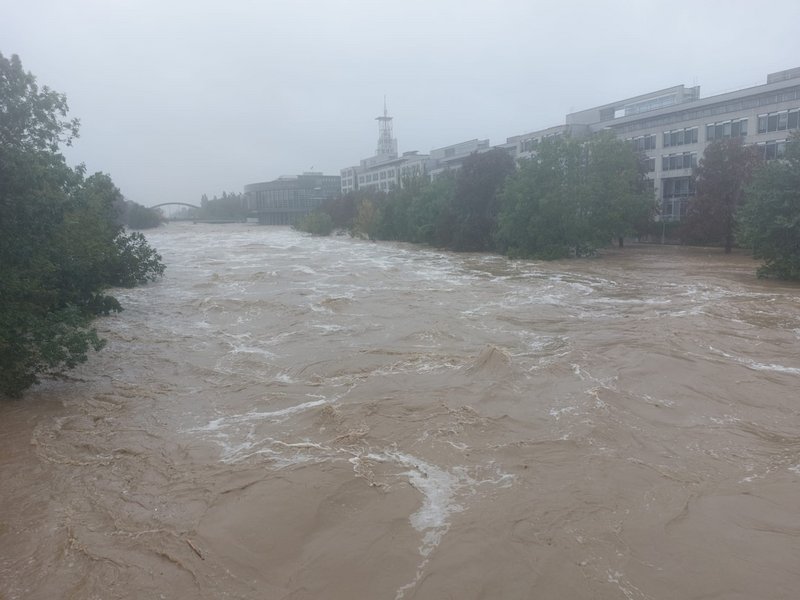


Heavy rainfall events in Austria have become more intense over the past 40 years. Short-duration extreme precipitation events in particular have increased significantly due to climate warming – and small-scale flooding events are consequently occurring more and more frequently, reports a consortium of three Austrian universities in the academic journal "Nature".
Compared to 1980, short-duration heavy rainfall events in Austria now bring noticeably more precipitation. This is shown by an analysis of two measurement series spanning over a hundred years, presented by a team of Austrian experts in the academic journal "Nature". There is a "strong upward trend" particularly for large, rapidly occurring amounts of precipitation, says hydrologist Günter Blöschl. They now bring on average 15 per cent more water. The reason is higher temperatures.
It's not often that a study based entirely on data from Austria, evaluated by researchers from the Vienna University of Technology (TU Wien), GeoSphere Austria, the Ministry of Agriculture and the University of Graz, makes it into the journal "Nature". However, in this case the findings are relevant to large parts of the world – and particularly to the mid-latitudes – explains Blöschl of TU Wien. The study demonstrates how rising temperatures play out at a regional level and what this means for the flooding situation.
You can read the article at science.orf.at, and the study entitled "Increasing hourly heavy rainfall in Austria reflected in flood changes" can be found at www.nature.com!
The Wegener Center at the University of Graz has also now investigated for the first time how these storms might change with climate change. "We expect persistent cut-off lows north of the 40th parallel and in East Asia to occur earlier in the year. Canada, northern Europe, Siberia and northern China in particular will need to prepare for more frequent long-lasting heavy rainfall in spring," says project leader Douglas Maraun. The results of the study have just been published under the title "Long-lasting intense cut-off lows to become more frequent in the Northern Hemisphere" in the scientific journal Communications Earth & Environment.