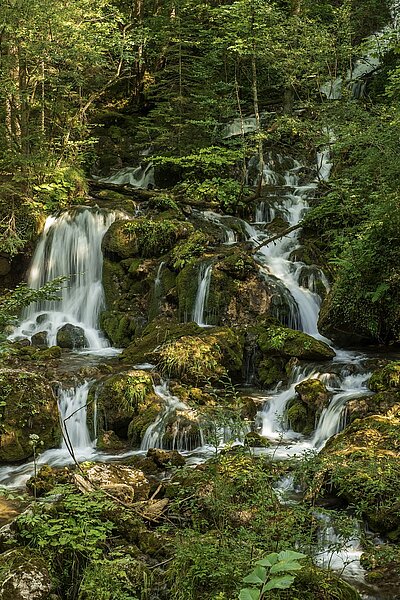


Ancient woodland in Austria. Yes, it exists. But there's very little of it left. The government is planning to put more land under nature protection. The forestry industry is up in arms. Protecting and using the forest, they say, aren't mutually exclusive. Is that true?
There are no paths here. We pick our way over rough terrain, past wild boar droppings — or so forest expert Matthias Schickhofer tells us, attributing the slightly pungent smell accordingly. "I'd rather not run into them," says our camerawoman. "There are wolves here too," Schickhofer replies with an amused smile. It's noisy — birds are chirping in a wild chorus. Every so often, a particularly loud cry stands out. It's the flight call of the black woodpecker. This is roughly what ancient woodland looks like in Austria. What it smells and sounds like.
There's not much of it left. The last large remnant of primeval forest is the Rothwald in the Dürrenstein-Lassingtal wilderness area in Lower Austria. A primeval or primary forest is one that humans have never altered — where no trees have been felled, no saplings planted, and no forestry tracks laid. You can't just wander into this forest either.
In the Kamptal region, where Matthias Schickhofer takes us through the woods instead, it's not primeval but natural forest. This is a forest with tree species typical of the local habitat. The forests are still natural in terms of their structure, complexity and biodiversity. However, there has been some human intervention.
Find out more at: moment.at