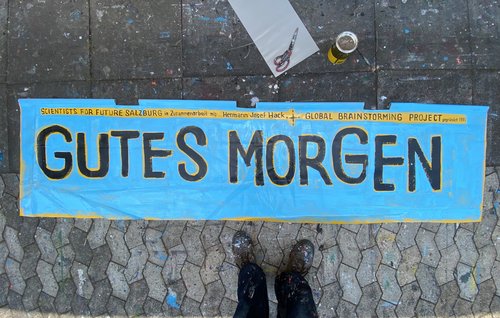


Salzburg's Wish-Net Publicly Fishes for Ideas for a Sustainable Future
An art & science project by Hermann Josef Hack for and with Scientists for Future (S4F) Salzburg
Opening performance on 24 June, 11 am in the Wilhelm-Furtwängler-Garten opposite the Haus für Mozart
Our society has been in the midst of managing a global crisis for well over a year now. COVID-19 and its wide-ranging impacts have exposed sore points in our system like no other crisis before it. As if a veil had been lifted, connections to further, present-day challenges became visible — climate change, biodiversity, spatial planning, food and the division of society. The good news, however, is that we have a great deal of knowledge. The question is whether it's being put to adequate use. The project 'Gutes Morgen' makes use of this time of decisions and transition to look ahead.
The project Gutes Morgen directly engages all residents and visitors of Salzburg, inviting them to reflect on what a sustainable future — particularly in a post-Covid world — might look like in their region, and to make their voices heard. Here's how it works: a net is strung up in the Furtwängler-Garten opposite the Haus für Mozart in the old town. Everyone is welcome to attach their suggestions for our future to it. "We need new narratives, utopias and visions of what the future should specifically look like here in the coming years," says artist Hermann Josef Hack, who developed the concept for the art project, "but we'll only find them if we involve everyone." The founder of the Aesthetics of Global Survival had previously collaborated with Scientists for Future Salzburg (S4F) and other experts at the University of Salzburg. Stefan Kienberger, researcher at the University of Salzburg and initiator of the project, says: "This project is particularly important for us as researchers — on one hand because it means stepping out of our comfort zone and actively engaging with the public together with the arts. But especially also to highlight the fact that we know a great deal, yet unfortunately action is often not taken accordingly."
Accompanying the project is a statement by Scientists for Future (S4F) Salzburg, in which Salzburg-based researchers summarise the key points on the current state of knowledge regarding climate protection, climate risk management, spatial planning, biodiversity, poverty & housing, and food in Salzburg. These ideas also serve as a starting point for the Gutes Morgen project and will be publicly handed over to decision-makers and the people of Salzburg as part of the event.
The aim of Gutes Morgen is to spark enthusiasm for shaping our future and engaging with the challenges that come with it, creating a connection between experts and the wider public. The net — to which wishes, suggestions, personal commitments and ideas can be attached via notes or other forms of expression — will remain in place for just over two weeks, until Sunday 11 July 2021, serving as an idea-catcher and communication platform. The contributions will be documented, compiled and then collectively handed over publicly to policymakers, so that they can feed into their decision-making.
You are warmly invited to the opening performance with Hermann Josef Hack and Scientists for Future (S4F) Salzburg on Thursday, 24 June 2021, 11 am, in the Wilhelm-Furtwängler-Garten opposite the Haus für Mozart. The art and science project will be installed until 11 July 2021. Contact for enquiries and interview requests:
Lara Leik, lara.leik@sbg.ac.at, 0043 670 408 2272
www.uni-salzburg.at/s4f/beauftragte
About Scientists For Future: Scientists For Future (S4F) is a non-partisan and cross-institutional network of researchers from various disciplines who are committed to a sustainable future. As a grassroots movement, Scientists for Future (S4F) actively brings the current state of science into the public debate on sustainability and future security in a scientifically sound and accessible way. The Paris Lodron University of Salzburg is currently home to the only S4F representative in the German-speaking world.
Hermann Josef Hack is an artist and founder of the GLOBAL BRAINSTORMING PROJECT, which he established in 1991 as an artistic communication platform. To date, he has demonstrated in over 200 projects — including collaborations with climate researchers in Austria — how the climate catastrophe can be addressed as a cultural question.
Further information about Gutes Morgen can be found in the attachment or via the following channels: :