

After Record-Breaking Hot Summer: New Report Warns of Health Risks from Climate Change
More tropical nights, higher pollen levels, new invasive insect species: Climate and Energy Fund presents assessment report unique across Europe
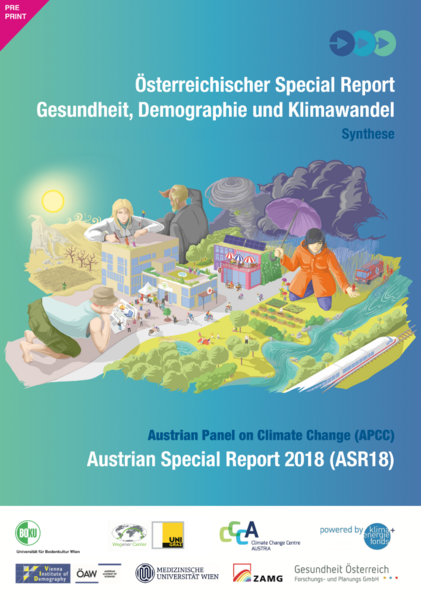
After the hottest May since 1868, the summer was also marked by record temperatures. That these changing climatic conditions are affecting our health is now confirmed by the first national assessment report on health, demography and climate change, commissioned by the Climate and Energy Fund and presented on 13 September together with the Federal Ministry of Sustainability and Tourism (BMNT). More than 60 Austrian researchers from the fields of medicine, climate and demography are in agreement: solutions can only be found by thinking across systems.
Summer 2018 will go down in history: all state capitals recorded significantly more hot days with a maximum temperature of at least 30 degrees than in an average summer; Vienna and Bregenz set new records with 32 and 16 consecutive heatwave days respectively. Vienna recorded a total of 40 tropical nights — more than in any other summer since records began.
"The record summer of 2018 has shown us: climate change is real and its effects are clearly being felt. The study commissioned by the Climate and Energy Fund has created a solid evidence base. Now we need concrete solutions to be prepared for the future. The Austrian Federal Government attaches great importance to climate protection. With the Austrian Climate and Energy Strategy <link https: mission2030.info _blank>#mission2030, we have created a foundation from which numerous measures and strategies are now being derived that are heading in the right direction. We must also strengthen cross-policy cooperation at national and European level in the area of climate protection", emphasises Sustainability Minister Elisabeth Köstinger.
Heat, extreme weather, allergies: climate change on our doorstep
"With this meta-study, Austria is a pioneer across Europe. It's the first assessment report to deliver cross-system facts at this level of quality and depth. It makes clear that over the coming years we need to focus on four key areas: heat, allergies, extreme weather events, and new invasive insect species. The Climate and Energy Fund has been laying the groundwork for years: through climate impact research such as the Austrian Climate Research Programme (ACRP) we are building a solid knowledge base, the <link http: klar-anpassungsregionen.at _blank>KLAR model regions are developing regionally tailored solutions, and with our programmes we are consistently driving forward the energy and mobility transition", emphasises Ingmar Höbarth, Managing Director of the Climate and Energy Fund.
According to the Special Report of the Austrian Panel on Climate Change (APCC), the number of hot days during heat episodes will double by the middle of the century, while at the same time the population will be older, with a 10% higher share of people over 65. Due to the growing number of tropical nights, during which insufficient cooling takes place, all these developments lead to significantly increased health risks, particularly in densely built-up areas. In the context of climate change, researchers also anticipate increased pollen exposure, particularly from ragweed (Ambrosia). Today, around 1.75 million people — roughly 20% of Austrians — are already affected by allergic conditions. If Austria follows the European trend, this could rise to 50% within the next 10 years. Subtropical and tropical mosquito species (e.g. the tiger mosquito and the bush mosquito) will also find better survival conditions here in future, requiring monitoring of their spread and the diseases they carry. And last but not least, more extreme rainfall, prolonged drought, and more severe storms are expected as a result of climate change, which not only causes high economic costs — for example through flood damage or crop failures — but also has local impacts on domestic water quality and availability.
Education, diet, exercise: everyone can live more healthily whilst protecting the climate
In order to actively drive forward the transformation of our overall system with regard to climate change and achieve the greatest possible impact, the team of more than 60 researchers believes it is necessary to consider climate and health not separately, but across systems. "Once we recognise the effects of climate change on all areas of our lives, it becomes possible to identify appropriate measures at the political, economic and scientific level, and also to make clear how each and every one of us can be supported in living a climate-compatible life", explains Willi Haas from the Institute of Social Ecology at the University of Natural Resources and Life Sciences Vienna and lead author of the study. In line with APCC quality standards, the Special Report underwent a multi-stage review process involving 30 reviewers and more than 2,000 comments, organised by CCCA.
In addition to mitigating the health impacts of climate change, the vulnerability of the population can also be specifically reduced by strengthening the climate-specific health literacy of health professionals and the general public. Supporting socially disadvantaged population groups — in particular by reducing the differences between urban and rural areas — can also help to prevent growing health inequalities resulting from the effects of climate change. The goal must be to provide the necessary educational opportunities so that people from all walks of life can access information about healthy lifestyles.
Behavioural changes — for example in the areas of diet or mobility — have a positive impact on both the climate and on health. A healthier diet based on seasonal, high-quality foods also makes a significant contribution to climate protection. Switching to electric mobility is an essential step; in addition, particularly in cities, it makes sense to prioritise public transport and active mobility: getting around by bicycle or on foot not only reduces emissions, but above all leads to more health-promoting physical activity in everyday life.
The assessment report on climate change and the study on health, demography and climate change can be accessed <link https: www.ots.at redirect klimagesundheit _blank>here and on the CCCA homepage at <link http: sr18.ccca.ac.at downloads _blank>sr18.ccca.ac.at/downloads/.
This <link https: www.ots.at presseaussendung ots_20180913_ots0061 nach-hitze-rekordsommer-neuer-bericht-warnt-vor-gesundheitlichen-risiken-des-klimawandels-bild external-link-new-window internal link in current>press release was published by the Climate and Energy Fund on 13 September 2018.
Press coverage:
- ZIB2 (13 September 2018): <link https: tvthek.orf.at profile zib-2 external-link-new-window internal link in current>Climate change has an impact on health – interview with Willi Haas
- Die Presse (15 September 2019): <link https: diepresse.com home science falsifiziert klimawandel-und-gesundheit external-link-new-window internal link in current>Climate change and health