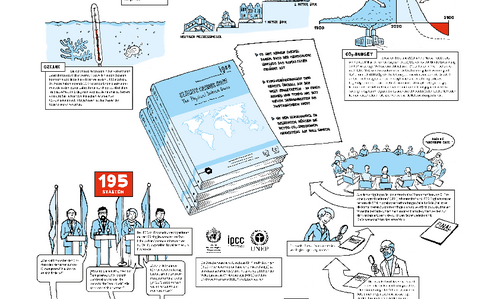


The newly published IPCC report confirms the key message of the appeal by Austrian scientists from December 2020, on the occasion of the fifth anniversary of the signing of the Paris Climate Agreement: "It is no longer possible to stabilise the global climate at 1.5°C of warming unless effective measures are taken without delay!"
According to the new IPCC report, significant emissions reductions will have a noticeable effect on the rise in greenhouse gas and aerosol concentrations and on air quality within as little as five to ten years, and a demonstrable effect on temperature rise within 20 to 30 years.
The Intergovernmental Panel on Climate Change (IPCC, the UN body responsible for assessing the science related to climate change) announced the publication of the first part of the Sixth Assessment Report (AR6) on Monday, 9 August at a press conference at 10 a.m.
Prepared by 234 authors from IPCC Working Group I, the report entitled "Climate Change 2021: The Physical Science Basis" summarises the current physical understanding of the climate system and climate change, as well as the latest advances in climate science. It provides the most up-to-date findings on warming projections, shows how and why the climate has changed to date, and includes an improved understanding of human influence on the climate (including extreme events). Greater emphasis is placed on regional information that can be used for climate risk assessments.
The key global findings of the new report include:
- The average temperature of the Earth is now 1.1°C above pre-industrial levels; global warming will continue and, averaged over the next 20 years, will reach or already exceed the 1.5°C threshold.
- Further warming will accelerate the thawing of permafrost, the loss of seasonal snow cover, the melting of glaciers and ice sheets, and the disappearance of Arctic sea ice in summer.
- Climate change is intensifying the water cycle. This is leading to more intense precipitation events and flooding, as well as increased drought in many regions.
- In cities, some aspects of climate change may be amplified, including heat, flooding from heavy precipitation, and, in coastal cities, sea level rise.
The remaining parts of the Sixth Assessment Report will be completed in 2022: the Working Group II report addresses impacts, adaptation and vulnerability; Working Group III provides an assessment of the options and measures for mitigating climate change. In summer 2022, an additional IPCC synthesis report will be published, providing an overview of the individual reports from the three working groups.
Thousands of people around the world contribute to the work of the IPCC. IPCC scientists assess thousands of scientific papers published each year for the reports. Based on this work, they are able to provide policy makers and the wider public with a comprehensive summary of what is known about the drivers of climate change, its impacts and future risks, and how adaptation and mitigation can reduce those risks. The last (fifth) assessment report was completed in 2014 and served as an important foundation for the Paris Climate Agreement.
Find out more about the IPCC, how it works and the key findings from the first AR6 report in our poster "New UN Climate Report: More Data, Better Knowledge"!
Current press coverage of the IPCC report can be found on our press page!