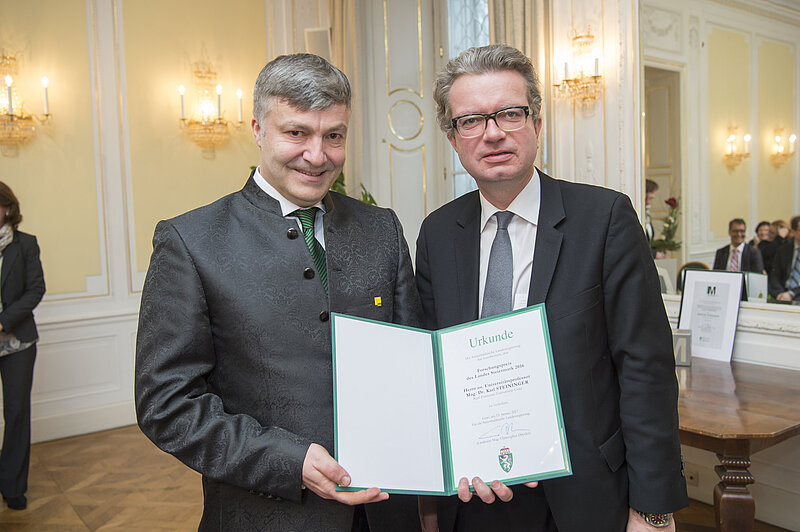


It has set a new standard in the economic assessment of climate change: the study from the "COIN" project not only reveals for the first time the consequential costs of climate change for Austria up to 2050, but is also more comprehensive in its consideration of relevant factors than any other similar study worldwide. The lead researcher, economist Ao.Univ.-Prof. Dr. Karl Steininger from the Institute of Economics and the Wegener Center for Climate and Global Change at the University of Graz, was awarded the 2016 Research Prize of the State of Styria for this outstanding work. State Councillor Christopher Drexler presented the prize on 13 January 2017 in the White Hall of Graz Castle.
"The recognition of this work underscores the importance and outstanding quality of the research by Karl Steininger and his team in the field of climate economics. This forms an essential pillar in the research focus on Environment and Global Change, through which the University of Graz acknowledges the high societal relevance of this topic", emphasises Rector Christa Neuper.
Climate change is making itself felt more and more noticeably in Austria with each passing year. In winter, this is felt particularly keenly by traditional ski resorts. However, the changes are fundamentally affecting all sectors of the economy. As part of a study led by Karl Steininger, the consequential costs of climate change in Austria up to 2050 were comprehensively calculated for the first time. "The costs arising from weather- and climate-related events will rise to four to five billion euros annually in the coming decades", warns the economist, "whereby this figure only accounts for damages that are already reliably foreseeable and furthermore represents an average value. Extreme events will burden us far more heavily in individual years", says Steininger.
The COIN project (Cost of Inaction: Assessing the costs of climate change for Austria), which involved 42 scientists from 18 research groups across Europe, was funded with 378,000 euros from the Climate and Energy Fund. The study was published in 2015 by Springer under the title "Economic Evaluation of Climate Change Impacts", and a summary article was published in the journal "Climate Services".
In terms of the breadth of climate change consequential costs, the study surpasses all previous investigations of this kind, including the US National Climate Assessment and the EU PESETA Project, and can serve as a model for future work. It describes current climate- and weather-related damages and identifies additional impacts that are expected as a result of global warming in the future. In doing so, it takes into account not only — as other studies do — rising temperatures and changing precipitation, but also the growing risk of extreme weather events. Yet it is precisely these that are expected to cause major damages and will likely be responsible for the lion's share of the cost increases.
Text: Gudrun Pichler (University of Graz).