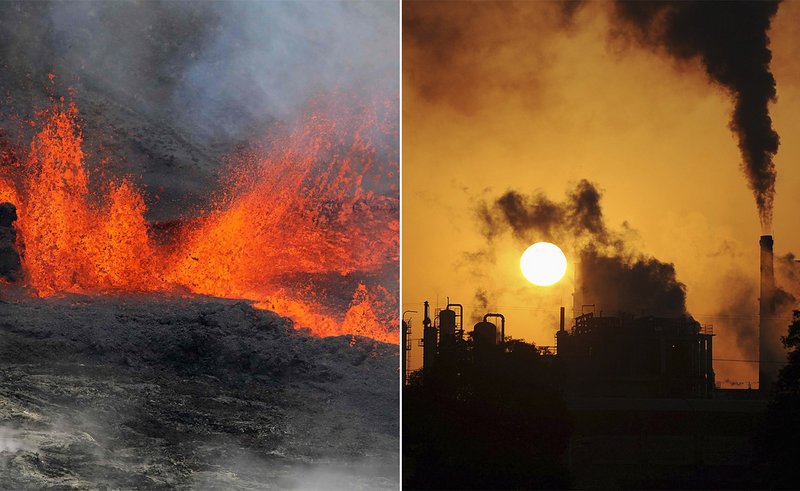


Researchers see parallels in carbon dioxide emissions. The global consequences up to 2100 are likely to be gradual losses in biodiversity.
Around 200 million years ago, at the transition from the Triassic to the Jurassic period, a massive extinction event wiped out roughly three quarters of all marine and land-dwelling species. This devastating event paved the way for the dinosaurs, who rapidly occupied the ecological niches that opened up and went on to dominate the Earth for the following 135 million years.
Most scientists consider the following scenario the most likely cause of the extinction at the Triassic-Jurassic boundary: when Pangaea, the most recent supercontinent in Earth's history, began to break apart in the late Triassic around 230 million years ago, extensive rift systems formed along the plate boundaries. This major geological event coincided with the formation of the Central Atlantic Magmatic Province (CAMP), covering eleven million square kilometres, at the Triassic-Jurassic boundary.
Read the full report at derstandard.at!