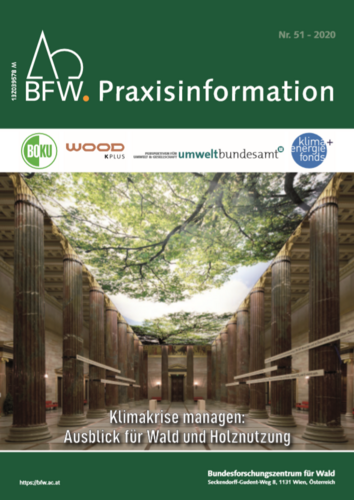


If humanity wants to achieve the Paris climate target and limit global warming to below 2 degrees Celsius, avoiding greenhouse gas emissions is the top priority. The use of timber plays an important role in this. Furthermore, Austria's forests cannot permanently serve as a net CO2 sink. These are some of the preliminary findings from the CareforParis project, which was funded by the Climate and Energy Fund and has now been published in BFW Practical Information 51.
Forests and timber play a significant role in climate protection, as forests absorb carbon dioxide from the air and store the carbon in wood. The consequences of climate change are reducing storage capacity. Necessary adaptation measures additionally affect the economic yields from timber as a raw material. When less timber is available, the necessary substitution often means additional emissions of fossil carbon into the atmosphere.
In the CareforParis project, in which the Federal Research Centre for Forests (BFW), the University of Natural Resources and Life Sciences (BOKU), the timber competence centre Wood K plus, and the Environment Agency Austria collaborated, various forest management scenarios were developed and analysed. The scenarios are based on different climate changes and adaptation strategies for Austrian forests and show possible developments up to the year 2150. The CO2 balance of forests and timber products, as well as the avoidance of CO2 emissions through the use of timber products, were analysed in greater detail.
Forests not a permanent carbon sink
Austria's forests, together with the timber product pools (sawn timber, boards, and paper), will — depending on the scenario — continue to represent a net CO2 sink for the next 20–90 years. After that, the scenarios paint a different picture: sooner or later, the forests will become a net CO2 emission source, because growth will decline in the long term. Contributing factors include poorer growing conditions (increasing dry periods), rising volumes of damaged timber (pest infestations, extreme weather events), and the type of management (premature harvesting or over-ageing).
The key is: avoiding emissions
Decarbonisation is the lever for achieving climate targets: we need to address the way we manage our economy. Our economic system must move towards a lower carbon turnover. One measure, for example, is the switch from fossil fuels to renewable energy. Timber is an indispensable raw material for decarbonisation. A high proportion of fossil raw materials is still being used in our economy today; there is now a great opportunity over the coming decades — until the phase-out of fossil fuels — to save a great deal of CO2 through the use of timber products. A sustainable, circular bioeconomy and the European Commission's Green Deal offer concepts for the future.
Download:
BFW Practical Information 52: CareforParis: https://bfw.ac.at/rz/bfwcms.download?dl=64612437
Enquiries:
Mag.a Marianne Schreck, marianne.schreck@bfw.gv.at