

A Few Degrees More – A Few Degrees, a Dramatic Effect
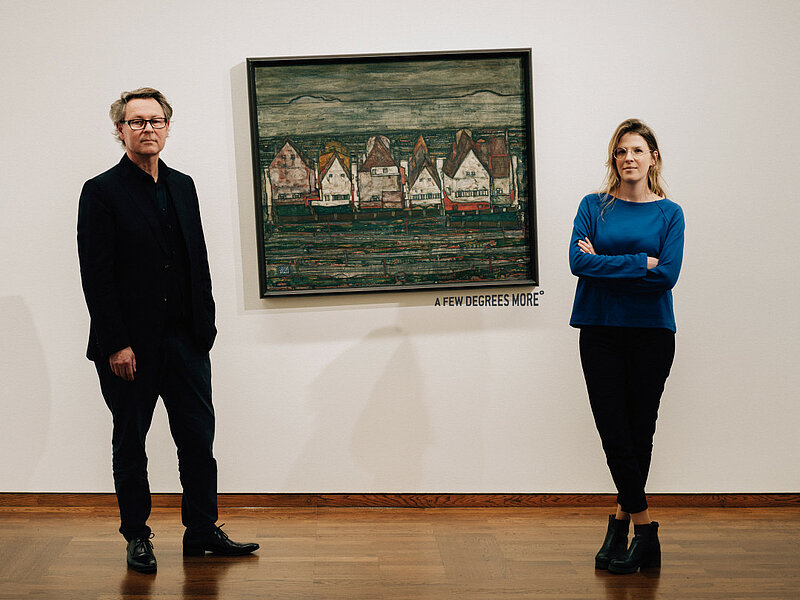
The Leopold Museum is hanging selected paintings by Klimt, Schiele and others at an angle to raise awareness of climate change.
For the past week, numerous tilted works by well-known artists at the Leopold Museum have been generating quite a buzz. Now the museum is setting the record straight: the world-famous landscape paintings were deliberately hung at an angle to draw attention to the dramatic impacts of global warming driven by climate change. Because a sustained temperature increase of just a few degrees can drastically reduce our quality of life.
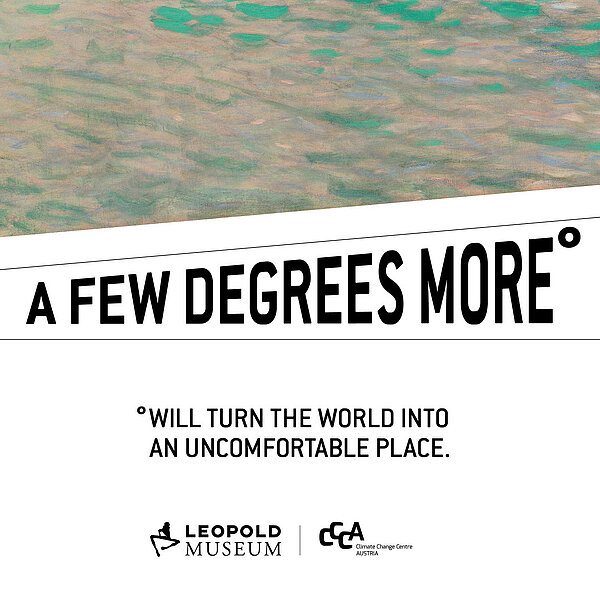
With the cautionary campaign motto A Few Degrees More (Will Turn the World into an Uncomfortable Place), the Leopold Museum, in cooperation with the climate research network CCCA (Climate Change Centre Austria) – one of the leading authorities in the field of climate research in Austria – is illustrating the potentially catastrophic effects that just a few extra degrees of temperature can have on the environment. According to current calculations by scientists and climate experts, these changes mean that the natural landscapes immortalised more than a hundred years ago by artists such as Gustave Courbet, Tina Blau, Gustav Klimt, Koloman Moser, and Egon Schiele in their paintings could soon disappear in their familiar form. To reflect this, world-famous landscape paintings from the collection have been tilted by exactly the number of degrees by which temperatures in the depicted regions – such as the Attersee area, the foothills of the Alps, or the Atlantic coast – could rise if far-reaching countermeasures are not taken in time.
Leopold Museum Director Hans-Peter Wipplinger is convinced that a wide variety of museum objects can be used to educate people about the consequences of climate change: "Engaging with the most pressing issues facing our society is a central concern for us at the Leopold Museum as an educational and outreach institution. Even the avant-garde artists of their time were seismographs of their era, offering visionary perspectives on the state of the world and the individual. Art museums are places where people can experience the world through the filtered gaze of artists and be confronted with themes, ways of thinking, and worldviews that can also be uncomfortable, challenging, or provocative. Museums inherently play a sustainable role in society by preserving and communicating cultural heritage for future generations. They see themselves as spaces for inspiration and reflection on our existence, and have the potential to positively influence our future actions by raising awareness of social phenomena. In this spirit, we declare our solidarity with the efforts of the climate movement."
In collaboration with CCCA, a team of 12 renowned researchers from various disciplines – ranging from meteorology and agricultural science to social science – investigated the impacts that climate warming could have on the motifs depicted in the selected paintings over the coming decades. The foundation for this work is the specific potential temperature increases indicated for each painting. In addition, the accompanying panels encourage visitors to take action against these developments in their own lives as well as at a structural and political level.
For CCCA board member and climate researcher Helga Kromp-Kolb, the campaign is a successful contribution to making abstract data intuitively and tangibly understandable, and to confronting people with an uncomfortable truth in an entirely new context: "For decades, scientists have been warning about a human-caused global temperature rise of more than 1.5 degrees with enormous consequences for humanity. But these figures are hard to grasp. We want to show what difference a few degrees more can make – globally, but also in our immediate surroundings: in the Alpine region, the lake districts, or in Vienna, a city that has been named the world's most liveable city multiple times."
"It has become clear that the straightforward transfer of knowledge doesn't lead to the necessary level of action. Cooperation with artists and cultural institutions can, however, build bridges here, as they offer sharper and more provocative forms and opportunities for engagement," adds Claudia Michl, Head of the CCCA office.
The Leopold Museum aims to send a signal to society through this curated intervention within the permanent exhibition Vienna 1900. The Birth of Modernism. Director Hans-Peter Wipplinger emphasises: "With A Few Degrees More, we want to proactively make a constructive contribution, in the hope that other museums and galleries will join this movement by turning their own art and cultural treasures into climate ambassadors through a similarly thoughtful intervention."
The original idea for this campaign was developed with the creative agency Wien Nord Serviceplan. Their Creative Managing Director Christian Hellinger explains the ambition behind the intervention: "Together with the Leopold Museum and our scientific partners, the climate experts at CCCA, we're generating awareness for greater climate consciousness without producing a single poster or other printed material. The works of Egon Schiele or Tina Blau-Lang become not only symbols of an environment thrown off balance, but also – supplemented by accompanying texts – educational warning signs of climate change, and are therefore far more than mere surfaces for projecting protest."
The intervention A Few Degrees More can be experienced from Wednesday, 22 March as part of the exhibition Vienna 1900. The Birth of Modernism at the Leopold Museum and will be on display until 26 June. Accompanying the campaign, the Leopold Museum offers free special guided tours of the 15 works in A Few Degrees More every Sunday at 2 pm, as well as 10 free school group tours, bookable at leopoldmuseum.org.
More information about this striking alliance between art and climate science is available on the museum's website, at afewdegreesmore.com and at ccca.ac.at
#afewdegreesmore #leopoldmuseum
Credits:
Auftraggeber/Client: Leopold Museum
Wissenschaftlicher Partner/Scientific Partner: Climate Change Centre Austria
Creative Lead, Concept, Creatives: Wien Nord Serviceplan
Fotographie/Photography: Andreas Jakwerth
Website design by Ja & Armin