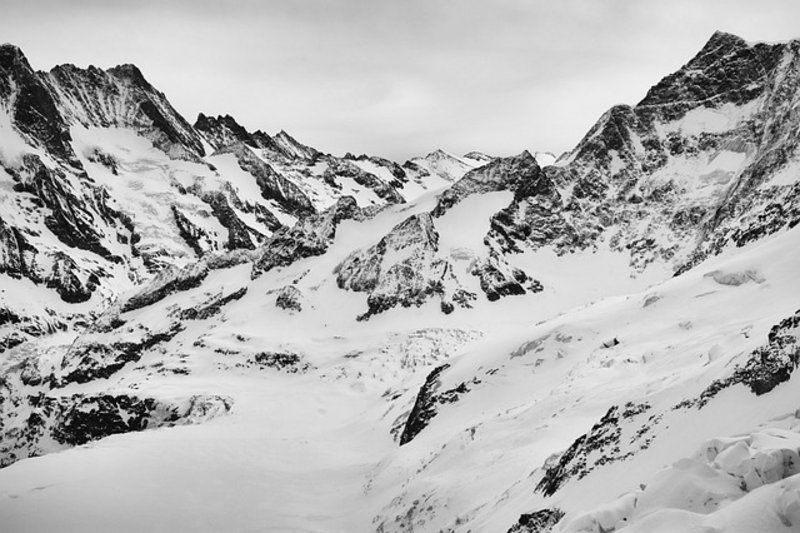


Immediately after the end of the Second World War, the US Air Force still had a number of combat pilots stationed in Europe. Rather than withdrawing them, they were used for a mapping project with the primary aim of documenting the efficient destruction using aerial images. A Graz-based research team led by glaciologist Jakob Abermann is now using these archival photographs to measure the glaciers as they were at that time.
"The 1940s are particularly interesting for us, because it was also relatively warm back then, meaning the snow line was very high in summer," reports Jakob Abermann from the Institute of Geography and Regional Science at the University of Graz. "The historical aerial photographs also offer a unique opportunity to analyse the glaciers comprehensively." Until now, only isolated surveys of individual ice fields have existed. Together with his project team, he managed to acquire copies of the images. A first look at the documents clearly shows the break-up of larger glaciers into small, almost static ice fields. The researchers also identified a number of newly formed lakes as well as changes to river courses.
Read more about the project at: uni-graz.at