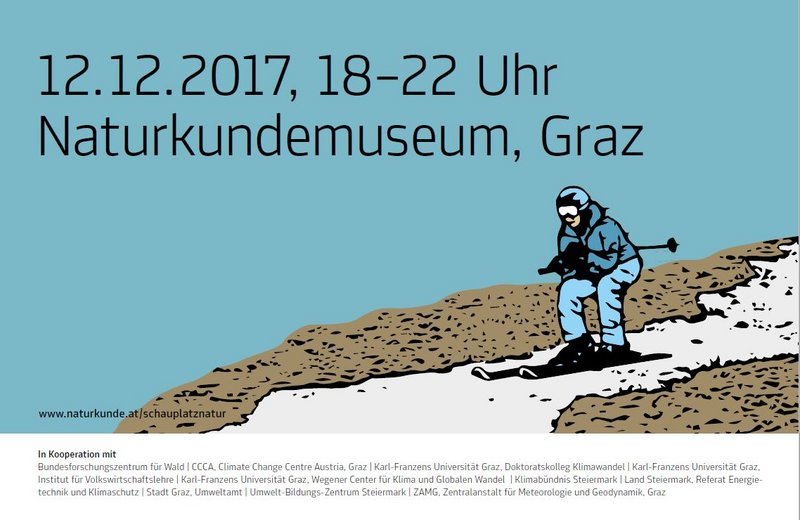


The Natural History Museum is tackling climate change. Together with experts from key Styrian research institutions, as well as the City of Graz and the State of Styria, this global development will be examined with a particular focus on its impacts on Graz and Styria. The Natural History Museum is becoming a place for information and exchange, for public education and answering questions from the community. What can we expect for the regions of Styria in relation to climate change, and what can each and every one of us do concretely about it?
2 Years After Paris - Where Does Climate Change Stand, and Where Do We Stand?
We now know that our human influences, above all CO2 emissions, have already been the predominant cause of climate change over recent decades, and that we will increasingly be the main driver of ongoing climate change in the future — and with it, growing climate-related damage — including in Styria.
Determined climate protection as a contribution to achieving the Paris 1.5 to 2 degree climate target, as a safeguard for our children and grandchildren, is therefore urgently needed in Styria as well. Adapting to the impacts of climate change — for example, to more weather and climate extremes — is equally essential.
But what are the conditions under which we can achieve the transition to a nearly CO2-emission-free economy and society, both at home and globally? What challenges and opportunities does this transition bring, and what can we do personally, in our own surroundings, in business, society, and politics?
The keynote at the themed evening "Climate Change and Styria" offers science-based answers to questions like these, and at the same time aims to encourage us, grounded in shared values, to contribute our part to climate protection and to collectively addressing climate change with reason, courage, and heart. Gottfried Kirchengast, Wegener Center für Klima und Globalen Wandel, Karl-Franzens-Universität Graz
Talks:
Styria and Snow
Global warming — what does it mean for the Styrian mountains and for snow in Styria? Will the white splendour disappear entirely in the future? What does all this mean for regions whose very existence depends fundamentally on cold and snow in winter? Andreas Gobiet and Christian Pehsl, ZAMG, Zentralanstalt für Meteorologie und Geodynamik, Graz
Climate Change and Its Costs
There is hardly an area that climate change doesn't affect. People, the environment, and the economy all have to adapt to changing climatic conditions. What do we need to do to keep damage and risks to a minimum? What does this climate change adaptation cost, and what does it deliver? Birgit Bednar-Friedl, Institut für Volkswirtschaftslehre & Wegener Center für Klima und Globalen Wandel, Karl-Franzens-Universität Graz
Fact-Checking the Climate Sceptics' Arguments
A lot is said about climate change and about the role humans play in it. Sceptical voices keep making themselves heard, particularly on the latter point. But what's actually true? We do the fact-check. Harald Rieder, Wegener Center für Klima und Globalen Wandel, Karl-Franzens-Universität Graz, and Stefan Ropač, CCCA, Climate Change Centre Austria, Graz
Climate Change Is Happening, but It Can Be Influenced
Hindsight is a wonderful thing, as they say, and so a look back into the past can tell us quite a bit about how we ended up where we are today. But the wise person plans ahead — so we also dare to look into the future, to understand which temperature developments we'd rather avoid and what we can do about them. Bettina C. Lackner, Doktoratskolleg Klimawandel, Karl-Franzens-Universität Graz
Graz and the Heat
Temperatures are rising, heatwaves are becoming more frequent, and large cities are particularly affected. What does that mean for a city like Graz and its residents? How can we prepare and learn to live with it? Dominik Piringer, Umweltamt der Stadt Graz
Palms in Graz, Parrots in Styria?
Our flora and fauna are changing — they have to change, to keep pace with shifting conditions. Which species are among the beneficiaries of climate change? Who is moving in and colonising local natural habitats, and which species will no longer be found in Styria in the foreseeable future? Vera Pallua and Daniel Zechner, Nature Education, Natural History Museum, Graz
Crazy Weather, or Something More?
Heavy rainfall, drought... the weather is getting ever more extreme — or does it just feel that way? What has always been around, and what is newly arriving in town and country as a result of climate change? What should we be prepared for? Douglas Maraun, Wegener Center für Klima und Globalen Wandel, Karl-Franzens-Universität Graz
Is the Spruce Running Out of Room?
And who might replace it? Planting a tree is said to be one of the three things you absolutely must do in life. But which tree would you choose today, if you need to think many decades into the future? And what will Styria's forests look like in 50 or 100 years? Silvio Schüler, Bundesforschungszentrum für Wald, Wien
Climate Change Adaptation and Styria
Climate-related adaptations to transport infrastructure, modifications to public utility networks, preparation for new health risks, disaster management — the tasks facing the State of Styria and its municipalities are varied and not always immediately visible. What's happening away from the public eye, and how well prepared is the State of Styria? Andrea Gössinger-Wieser and Adelheid Weiland, Referat Energietechnik und Klimaschutz, Land Steiermark
Tuesday, 12.12.2017, 6–10 pm
Natural History Museum, Graz
8010 Graz, Joanneumsviertel
joanneumsviertel@museum-joanneum.at
T +43-316/8017-9100
<link http: www.naturkunde.at schauplatznatur>www.naturkunde.at/schauplatznatur