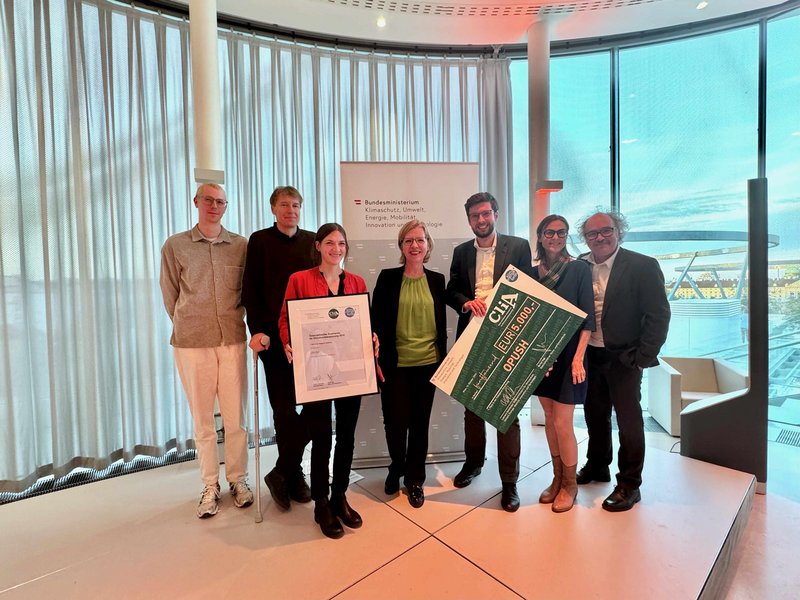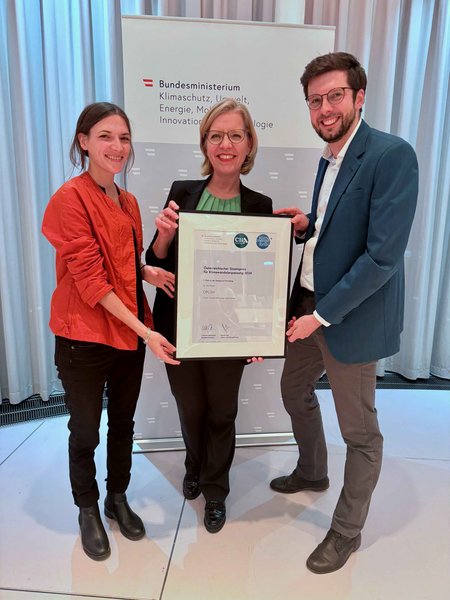


On 16 October, "CliA", the Austrian State Prize for Climate Change Adaptation, was ceremonially awarded at the MuseumsQuartier. This highest state honour puts particularly exemplary climate change adaptation projects in the spotlight. In the special category "Research", the project "OPUSH – Citizen Science Pilot Urban Heat Stories" by future.lab TU Wien Architecture and Spatial Planning together with TU Wien Library and the environmental NGO Luftdaten.at took the prize.
Urban agglomerations are particularly affected by increasing heat as a result of climate change, as large areas are sealed with impervious surfaces, buildings absorb heat and radiate it back at night, and corridors for cooling air circulation are often absent. During heat extremes, high air temperatures frequently coincide with elevated particulate matter pollution. This can rapidly push the human body to its limits. Within the population, there are particularly vulnerable groups who are at risk from heat extremes, such as older people, infants and children, and people who are ill. In order to integrate their needs into sustainable urban development in a long-term, evidence-based way and to strengthen the social dimension of climate change adaptation, "OPUSH" addresses the question of what heat-related experiences vulnerable groups have in their residential environments. The results were made available to the City of Vienna, among others, and were thus able to feed into the planning processes for the redesign of a "Supergrätzl".
The project involves heat-vulnerable individuals as co-researchers. In 2023, the urban districts of Innerfavoriten and Sonnwendviertel were examined, where places such as Quellenplatz are located in a heavily affected area according to Vienna's Urban Heat Vulnerability Map. Senior citizens aged 70 and above identified locations on a simplified neighbourhood map that are significant to them across various aspects of daily life (health, recreation, socialising, transport, local amenities, culture, sport) and shared personal stories about their temperature perceptions at these spots. This was followed by temperature measurements using mobile sensors at the selected locations during a walk. These measurements could be tracked in real time via a smartphone app. "This gives us knowledge about the usage patterns and needs of people who are particularly vulnerable to heat, which represents a valuable contribution to planning public space redesigns for climate change adaptation," says Christian Peer from TU Wien. "Citizen science and experimental urban planning are combined here as two innovative approaches. We're delighted that this approach is being recognised with the State Prize."
Climate change adaptation is becoming increasingly important for cities and municipalities as a second pillar of climate policy. The methods used in OPUSH allow municipal adaptation strategies to be complemented by an essential social dimension. "Our goal as a citizen science organisation is to promote public participation and to make vulnerable groups visible and empowered to act," explains Silvio Heinze. He is the managing director of the environmental organisation Luftdaten.at, which develops and manufactures, among other things, the mobile measuring devices that are also frequently used in workshops with school pupils. "The devices are easy to use and let you research your own environment, whether you're 7 years old or 77. Through projects like OPUSH, cities and municipalities can not only obtain important data for their urban development, but also strengthen citizens' awareness and competencies in dealing with the impacts of climate change," adds Luftdaten.at chairwoman Anna Hämmerle in closing.
Enquiries: Tina Wirnsberger, tina.wirnsberger@luftdaten.at, www.luftdaten.at