


Reference plan as a basis for a scientifically sound National Energy and Climate Plan for Austria that is in line with the Paris climate targets (Ref-NEKP)
Assessment of party positions ahead of the Austrian National Council election 2019, based on the Ref-NEKP of the scientific community
Based on the Ref-NEKP recently presented on 9 September 2019 (see weblink above), the project "Assessment of Party Positions" was carried out to help answer the following question:
To what extent are the positions of the six primary electoral parties (FPÖ, GRÜNE, JETZT, NEOS, ÖVP, SPÖ) in line with the framework measures and framework objectives as well as sector-specific policy packages that, according to the Ref-NEKP of the scientific community, are crucial for Austria's pathway towards the Paris climate targets?
The project was carried out on the initiative and under the leadership of Gottfried Kirchengast (Uni Graz, ÖAW), the scientific representative on the National Climate Protection Committee (NKK), together with Helga Kromp-Kolb (BOKU), Sigrid Stagl (WU) and Karl Steininger (Uni Graz) from the Ref-NEKP Steering Committee, and was supported in terms of subject matter by further colleagues from the CCCA climate research network.
The assessment results are now available. They are provided in the form of a concise results document containing introductory information, two results tables, and further information on content, procedure, methodology, and the people involved:
Results tables directly as graphics - minimum citation "Source: CCCA via ccca.ac.at/refnekp - Assessment of Party Positions, 2019":
- Ref-NEKP Assessment of Party Positions - Results table: Framework conditions and framework objectives (jpg 2.94 MB)
- Ref-NEKP Assessment of Party Positions - Results table: Sector-specific policy packages (jpg 2.38 MB)
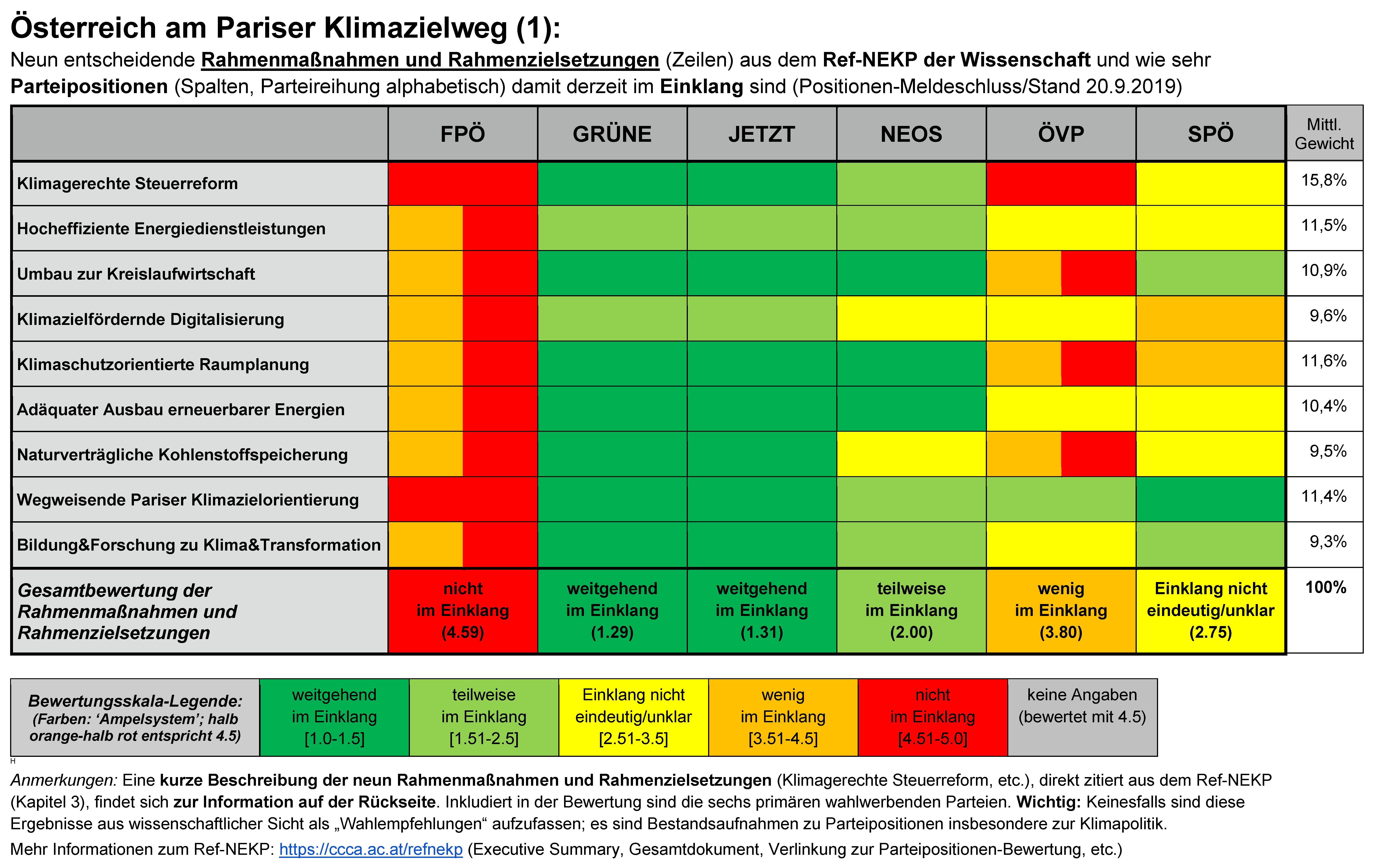
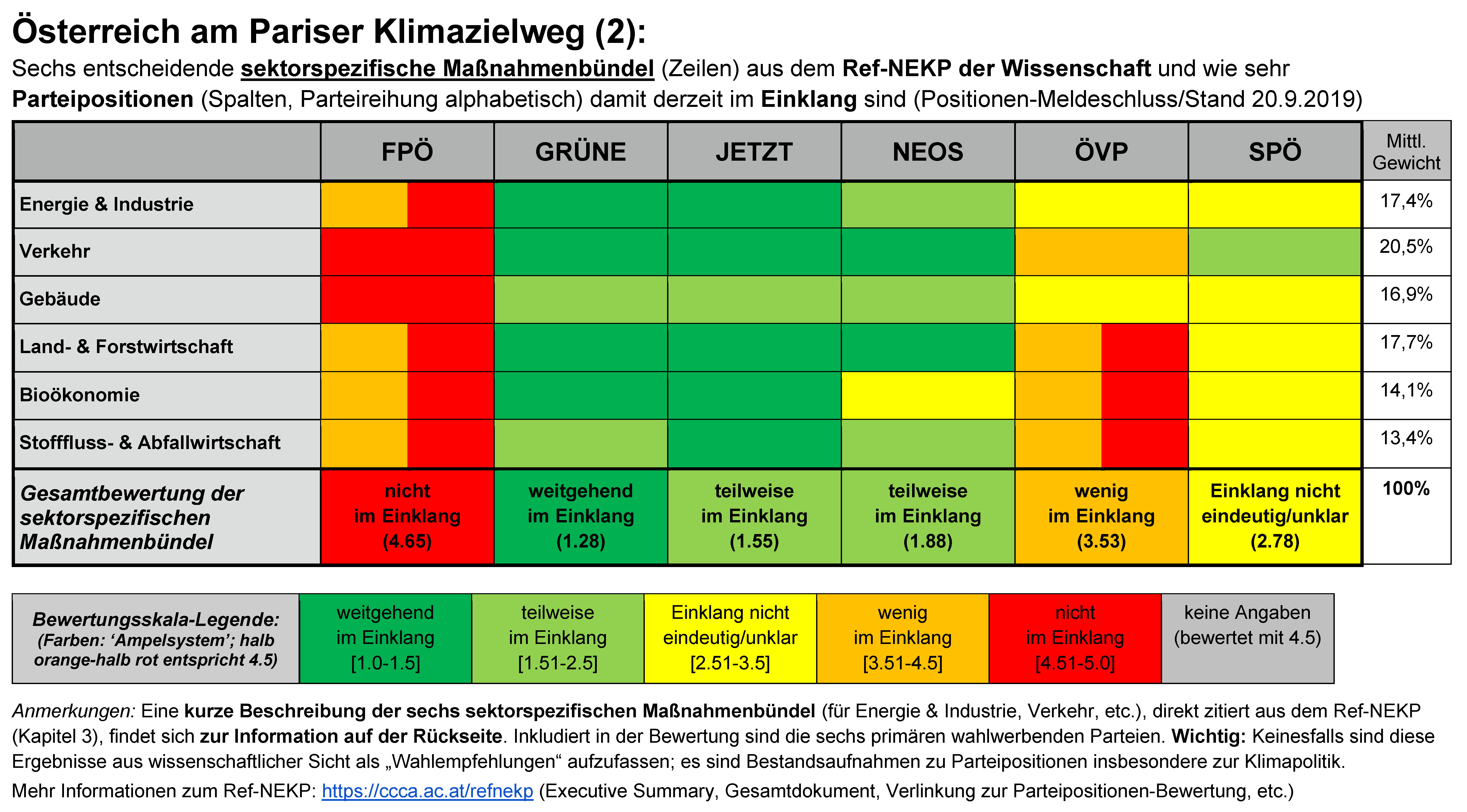
Overview information on this assessment, including statements from members of the Ref-NEKP Steering Committee, can be found in this CCCA press release from 25.9.2019:
The assessment was carefully carried out using a "Structured Expert Assessment" method, in which the final assessments were derived from median results and weighted individual and independent evaluations by the eight members of the expert consortium (for further details see the results document PDF on page 6). It is intended primarily as a guide for anyone who appreciates as objective an orientation as possible regarding the extent to which the parties' electoral programmes currently offer serious political support for Austria's pathway towards the Paris climate targets.
Due to the advance announcement of their publication on 25.9.2019 at the Ref-NEKP press conference on 9.9.2019, the results had already attracted numerous enquiries beforehand — CCCA therefore invites all interested parties to make use of the information on this webpage.
Statements from members of the Ref-NEKP Steering Committee on the assessment results:
Climate researcher Gottfried Kirchengast, who coordinated the project, explains: "It's important to note that, despite our efforts to be objective and thorough, the results represent a partially subjective overall assessment and should therefore by no means be interpreted as voting recommendations from a scientific perspective. Rather, they are a stocktake of party positions on climate policy, which as such paint a strongly differentiated picture, particularly with regard to the seriousness of ambition on climate protection. At the same time, we know that in all parties there are people for whom the climate issue and effective political measures are a major concern."
Climate economist Sigrid Stagl highlights the growing climate expertise within some parties and the elimination of "blind spots": "The comparison shows that among the Austrian parties there are real climate protection professionals, and some have significantly improved their programmes recently. Proposals for an ambitious and coherent concept for a future-oriented economy without fossil energy are on the table. The challenge will be to not focus on differences in the political process, but to enable joint initiatives and tackle urgently needed changes on a sufficient scale and swiftly."
Karl Steininger from the Wegener Center at the University of Graz particularly highlights the further potential for parties to develop an integrated environmental and economic policy, and offers encouragement: "We in Austria presumably all want to preserve a liveable planet for our children — in that sense, the goal is probably beyond dispute. To truly achieve this goal, what's needed above all is a shift in thinking and an honest, shared search for how we can achieve a higher quality of life in a climate-friendly way. Politics, science, and the people of our country — the dialogue made possible on the basis of an honest stocktake has great potential to turn this better future into reality."
And climate researcher Helga Kromp-Kolb adds: "The climate issue isn't going away — it will continue to be with us for decades. The climate crisis demands political cooperation and social cohesion — despite the differences in the electoral programmes. Cooperating across political parties is in keeping with good Austrian tradition. This is something that is once again particularly called for now."
You will also find here the two background documents with the survey results on party positions: