

Impressions from the 29th Climate Conference in Baku
A report by Alexander Griebler (MUL) and Lisa Waldschütz (CCCA)
The 29th UN Climate Conference (COP29) took place this year in Baku, Azerbaijan. Although expectations for the conference were low, the urgency to achieve meaningful progress was very high. Unfortunately, COP29 has left a bitter aftertaste and raises many critical questions.
The COP has now taken place for the third time in a row in an autocratic regime — a regime that is massively dependent on fossil fuels, tramples on human rights, and threatens those who stand up for justice and social change. At the same time, the hypocrisy of industrialised nations shouldn't be underestimated. Our money props up these inhumane systems — for example, Italy signed new supply contracts for natural gas and oil with Azerbaijan at the COP. It is urgently necessary that the EU in particular reflects on its core values and acts as a genuine champion of peace and the environment. This means no longer doing business with autocratic regimes and creating an equitable economy in which all partners — including the most vulnerable — are treated as equals. That requires ambition, yet ambition is precisely what the EU has been lacking in the negotiations. It was seemingly never about finding an adequate contribution to climate finance, but rather about making the smallest possible contribution without completely losing face. It's no surprise that the transition towards a resilient system is being blocked by oil-producing nations. What is surprising is the role of the industrialised nations, whose behaviour contributes nothing to breaking this deadlock — behaviour that, given their stated ambitions (Green New Deal), their responsibilities, and their capabilities, would not necessarily have been expected. Time is pressing. Yet neither in politics, industry, nor in large parts of the NGO landscape is there any visible will to do what is most necessary to break the vicious cycle of the climate crisis.
Article 6: Negotiations on Carbon Markets
An important item on the COP29 agenda was the negotiations on Article 6 of the Paris Agreement, which sets out the rules for international carbon markets. These negotiations were intended to be concluded in order to establish clear guidelines for emissions certificate trading and thereby support global efforts to reduce greenhouse gas emissions.
By the end of COP29, the parties were able to agree on a common set of rules. The decision is generally regarded as a step forward, but due to the complexity of the rulebook, critics warn of the risk that loopholes could emerge that countries and companies might exploit. Calls were also made for stricter and clearer rules to ensure that carbon markets actually contribute to real emissions reductions.
Climate Finance (New Collective Quantified Goal on climate finance, NCQG)
The main topic in Baku was climate finance. Climate finance was to be strengthened and increased in order to provide countries in the Global South with a degree of security and to signal the support of the Global North — for the transition, for climate change adaptation, and for dealing with climate change-related losses and damages.
The previously set goal was to deliver payments of 100 billion dollars to countries in the Global South. Countries in the Global South now called for this to be increased to 1.3 trillion dollars, with a minimum increase to 500 billion dollars by 2030. There is also criticism of the existing composition of the financing. Around 42% of it consisted of non-concessional loans — that is, loans traded at market-rate conditions (interest rate, repayment period, etc.). One demand from the LDCs (Least Developed Countries) was that states issuing these loans should not be charging interest on them.
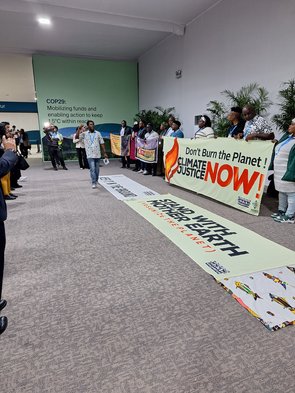
Civil society also repeatedly called for financial commitments to be scaled up from billions to trillions in order to meet the challenges of climate change. Civil society's demands were voiced loudly and clearly through demonstrations throughout both weeks.
Agreement at the End
In the end, the parties agreed on a number of measures that nonetheless fall far short of expectations. It was decided to increase annual financial assistance for countries in the Global South to at least 300 billion dollars per year by 2035.
In Austria alone, the flooding in September caused damage amounting to 1.3 billion euros (in 2023, the damage in the Ahr valley in Germany amounted to 60 billion euros). By comparison, the international community has agreed on global financial assistance that amounts to just 230 times that figure (by 2035) — and this for a global crisis response and energy transition affecting billions of people. For context: the total land area of the Earth is roughly 1,776 times larger than Austria. Yet while Austria, thanks to its relatively sheltered geographical location and excellent protective infrastructure, can at least mitigate damage of this kind, many countries — particularly in the Global South — are largely defenceless against such extreme weather events. There, not only are the means for protective measures lacking, but often also the resources for reconstruction after a disaster — and that's before we even talk about the funds needed for a transformation of energy infrastructure. This inequality underscores the urgency of not only increasing climate finance, but finally aligning it with the reality and actual needs of the regions affected. Nothing less than the safety and survival of tens of millions of people living in extremely vulnerable conditions is at stake.
Although the figure of 1.3 trillion dollars was mentioned as a future target, no detailed information was provided on where the funds would come from or how this is to be achieved by 2035. While it was agreed to reduce the share of non-concessional loans and instead offer more grants and interest-free loans, despite these decisions it remains doubtful that these measures will even come close to providing the urgently needed support for the countries most affected by climate change.
It seems like a cruel joke that the final decision text underscores the need for emerging economies and Global South countries to meet a financing requirement (based on their Nationally Determined Contributions) of 4.87–6.49 trillion euros by 2030, while simultaneously treating the 300 billion as a maximum and a pain threshold. Even after COP29, it remains unclear what sources will actually make up the climate finance. It is quite possible that this will only be finally settled at COP30 in Brazil next year.
COP29 in Baku has shown that the international community is far from being able to collectively and effectively tackle the challenges of climate change. A genuine display of political will is needed to bring about the necessary changes. The demands of civil society for greater transparency, fair financial support, and more ambitious emissions targets must finally be taken seriously. The failure of COP29 is not the failure of any individual — it is a collective failure.