
Products & Standards

APCC Products

APCC products serve to survey, summarise and assess the current state of science and research on thematically defined questions (Special Report) or on climate change as a whole (assessment reports). Proposals for topics are developed with regard to the knowledge needs of relevant practice fields in a consultation between the AG APCC, CCCA board and the APCC Steering Committee (APCC SC), and are put forward to potential funding partners. APCC products assess the current state of scientific knowledge and may also include conclusions on future research needs. APCC products are produced with the involvement of the entire relevant Austrian scientific community. They serve a communicative purpose and are disseminated to a broad public once completed. Where needed, suitably qualified and appropriately recognised international experts can be brought in to contribute to the production of APCC products. The Austrian Panel on Climate Change (APCC) does not carry out research projects itself, and APCC activities are not aimed at generating new knowledge in the sense of discipline-specific or inter- or transdisciplinary research. They bring together existing knowledge on climate change. The following products can be produced as APCC products provided the APCC criteria are met:

  • Assessment Reports, i.e. comprehensive assessment reports similar to the AAR14, which present the state of science and research on climate change relevant to Austria (in the sense of the CCCA definition of climate research) in a thorough and needs-oriented manner. These include both technical/scientific and policy- or public-facing synthesis reports ("technical summary", "summary for policy makers") and should be produced approximately every 10 years. No new research is to be conducted; rather, the current state of research is to be presented.
  • Special Reports on defined topics. These represent a deeper exploration of the assessment report based on updated findings relating to a defined topic. Special Reports also build on already established knowledge and identify knowledge gaps without conducting new research themselves. That is, they set out what is known about a particular topic. They likewise include a technical/scientific as well as a policy- or public-facing synthesis. Special Reports can also go into greater depth on regional specifics. Special Reports should furthermore be incorporated into subsequently produced Assessment Reports, with redundancies kept to a minimum.

APCC products are aimed at all decision-makers and public opinion-formers in the fields of politics, business, education, science, society and beyond. They serve to inform policy at all levels (federal and state level) and are also directed at other relevant institutions such as chambers, associations, etc.

APCC reports are funded by the ACRP programme of the Climate and Energy Fund.
APCC Quality Standards

APCC products must meet the following criteria:

  • They must demonstrate sufficient breadth with regard to specialist scientific treatment. APCC products are generally produced with the involvement of all relevant scientific disciplines. They address topics rather than specific individual questions.
  • Participation in the production of APCC products is open to the entire Austrian community. The CCCA office is informed of the project in advance and invites participation in the production of APCC products through CCCA communication channels; in doing so, it also notifies all CCCA member representatives. The respective project consortium is responsible for ensuring broad representation of the Austrian community. APCC products are presented and discussed at the CCCA Klimatag by the respective project consortium during the course of their production.
  • APCC products undergo a rigorous quality assurance process that is open to the relevant scientific community in the German-speaking world. Prior to publication, sufficiently broad and thorough review by external reviewers must be ensured, as well as appropriate and scientifically sound incorporation of all comments arising during the review process. The steps required for the quality assurance process are listed below under "Steps of the Quality Assurance Process".
  • APCC products are written in accordance with calibrated language and thus follow the IPCC credo "policy-relevant, not policy-prescriptive".
  • The project leadership and the Co-Chairs are responsible for transparency and process quality, which is monitored by the APCC. To ensure transparency, documentation on the CCCA/APCC website is to be maintained, coordinated by the CCCA office. The CCCA/APCC website must feature descriptions of the APCC product in development, list the relevant contact persons, and make available papers for download.

APCC Structure

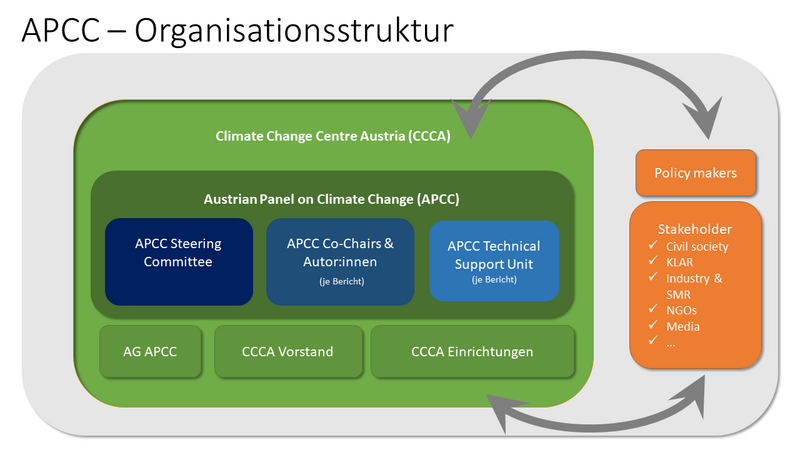
The graphic below illustrates the APCC structure and shows the exchange with political decision-makers and other stakeholder groups for APCC reports. The responsibilities of the individual roles within APCC products are closely aligned with the procedures and guidelines of the Intergovernmental Panel on Climate Change (IPCC).

  • Co-Chairs are the project leads of the report and are responsible for the overall architecture, structure, organisation and content of APCC products, as well as for all financial and editorial aspects of the report.
  • Technical Support Unit (TSU) supports the Co-Chairs as the central point of contact for authors and other contributors to APCC products, such as funding partners and stakeholder groups. The TSU also handles all further supporting and coordinating tasks within the report.
  • CCCA office supports the process, coordinates the APCC SC, and assists with quality assurance upon commissioning by coordinating the review process (review management), maintaining close communication with the Co-Chairs and the TSU for this purpose.
  • CCCA service centre supports the process and, upon commissioning, organises stakeholder dialogues and workshops at individual stages of APCC products, liaising with the Co-Chairs and the TSU for this purpose.
  • CCCA board has no direct management function within APCC products, but supports the process and can contribute in an advisory capacity. The exchange of information between the CCCA board, the Co-Chairs and the APCC SC aims to make use of the CCCA network in order to achieve broad participation in the review process and in dialogue with stakeholder groups.
  • Policy makers & stakeholders are invited to workshops, dialogue formats and the review process in order to ensure the practical relevance of APCC products.
  • A detailed description of the APCC SC and the AG APCC can be found here.

Further Roles

In addition to the roles mentioned above, there are further functions that closely follow those of the IPCC.

  • Coordinating Lead Authors (CLA) coordinate the individual chapters. They act as the lead scientists for the respective chapters and develop the chapter content together with the Co-Chairs, the LAs and the CAs. The CLAs, together with the Co-Chairs, select the CAs and LAs and are responsible for the relevant chapter content and links to other chapters of the APCC products.
  • Lead Authors (LA) are scientific experts who contribute to one or more chapters of the APCC products. LAs are selected by the CLAs of the individual chapters together with the Co-Chairs and are responsible for the subsections of the relevant chapter as well as for coherence and synergies with other sections/chapters of the report.
  • Contributing Authors (CAs) are scientific experts who contribute or prepare diagrams, text or data that are incorporated into the APCC products.
  • Reviewers can submit comments and annotations on a sentence, section, entire chapter or on the complete report in general. They may address the scientific content or the structure of the report. They often point to published work that the report's authors may not have included in their assessment, but which could be relevant.
  • Review Editors (RE) ensure that all comments from the Second Review by scientific experts and stakeholders have been appropriately taken into account, and advise the Co-Chairs and CLAs on how to handle critical or controversial comments, ensuring that these are adequately addressed in the report. The REs are not involved in drafting the parts of the APCC products that they review.

Review Process

To ensure the quality of APCC products, there is a review process modelled on that of the IPCC. The APCC SC examines the structure of the review process in the sense of a "concept review" and provides relevant feedback to the project consortium (e.g. Co-Chairs) regarding the structure and compliance with APCC standards. The following steps must be followed:

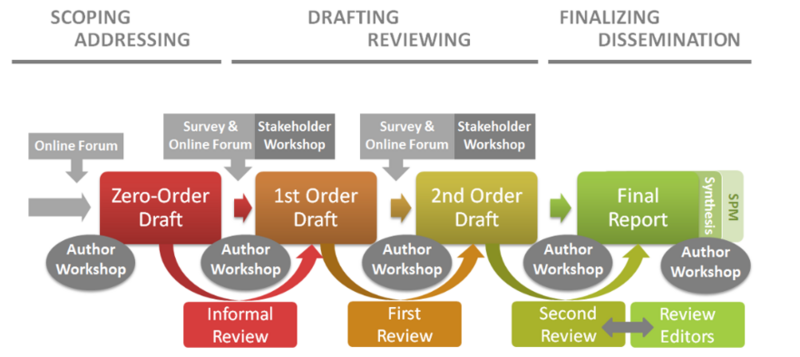
  1. During the scoping phase, the key thematic priorities and outline of the APCC product are defined. This produces the Zero-Order Draft, which is reviewed internally by the author team. The scoping phase also establishes the review process steps and outlines how APCC standards will be upheld.
  2. A first revision by the author team then takes place, resulting in a First-Order Draft. This First-Order Draft subsequently enters an external review process (carried out by national and international reviewers from the scientific community). The APCC SC checks the First-Order Draft for compliance with APCC standards. The comments from the external reviewers are then incorporated by the author team. The author team records, for each individual comment, whether and, if applicable, how it was taken into account, or provides a reason why it was not.
  3. The quality of the incorporation of comments in the form of a Second-Order Draft, as well as the reasons for any non-consideration of comments, must be examined by Review Editors. To this end, the project consortium must additionally recruit suitable international experts as well as any relevant stakeholders, potentially supplemented by suggestions from the APCC SC. A Second-Order Draft is also reviewed by the APCC SC for compliance with APCC standards.
  4. Once the Review Editors and the APCC SC are satisfied that all comments have been incorporated in a sound and scientifically appropriate manner and that APCC standards have been met, the report can go to print following appropriate final editing, technical finalisation and layout.
  5. A synthesis and a Summary for Policy Makers must be produced for each APCC product.

Reflection on the Development Process

Published on 20 May 2023: Managing a special report: Reflections on the genesis of the Austrian assessment on health, demography and climate change. O.Koland & W.Haas (2023). GAIA 32/1, 94-101.

The paper is intended to provide guidance for coordinators, future authors and writing teams, and is available here.

Contact

Please get in touch at info@ccca.ac.at if you're planning to submit an APCC report as part of the ACRP call, or if you have any further questions about the APCC SC & working group, submissions, products or guidelines.