


A working group of the weather services of Germany, Austria and Switzerland, along with various federal, regional and climate research institutions, has put together a recommendation for a standardised German-language description of the climate scenarios of the Intergovernmental Panel on Climate Change (IPCC).
On 4 April 2022, the Intergovernmental Panel on Climate Change (IPCC) presented the findings of Working Group III of the new IPCC report (AR6), which focuses on "measures for climate protection". CCCA also organised a press conference on this — see here.
Climate scenarios are an important foundation for developing targeted climate protection measures, as well as for climate research more broadly.
What are climate scenarios?
Climate scenarios are estimates of how the future climate will develop under certain conditions. They make different assumptions about the development of society (e.g. world population, urbanisation, education) and the economy (e.g. type of energy generation, technological progress, economic growth), and take into account the associated development of climate-relevant greenhouse gases and aerosols, serving as boundary conditions for climate models.
This makes it possible to assess the effects of different socioeconomic developments independently of climate protection, and of varying degrees of climate protection effort, either separately or in combination.
No standardised terminology until now
Until now, there was no standardised terminology in German-speaking countries, which meant that various names for the same climate scenarios had been used in recent years. This often led to confusion and mix-ups. To address this, a working group of the weather services of Germany, Austria and Switzerland, along with various federal, regional and climate research institutions, drew up for the first time in early 2022 a recommendation for a standardised naming, description and colour coding of a selection of IPCC climate scenarios.
Clear language as the basis for broad understanding
Austria's representatives in the working group were Marc Olefs, Head of Climate Research at the Central Institute for Meteorology and Geodynamics (ZAMG), and Thomas Schinko, Research Group Leader at the International Institute for Applied Systems Analysis (IIASA).
Marc Olefs (ZAMG): "Clear, standardised language is the foundation for understanding the long-term consequences and impacts of different measures. That, in turn, is the prerequisite for achieving broad support for the importance of climate protection measures and for moving from knowledge to action."
Thomas Schinko (IIASA): "This now-standardised scenario language enables the German-speaking climate research community and media landscape to communicate the latest research findings without ambiguity. The concise descriptions of the climate scenarios provide an important basis for developing climate protection measures and define the challenge for adaptation to the impacts of climate change."
The scenarios
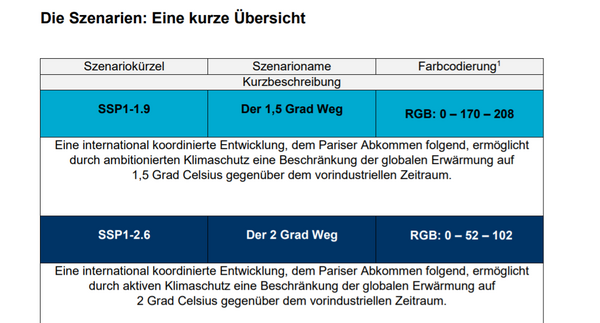
Here's a brief description of the new, uniformly formulated scenarios used in the sixth assessment report of the IPCC:
The 1.5 degree pathway (SSP1-1.9)
An internationally coordinated development, in line with the Paris Agreement, enables global warming to be limited to 1.5 degrees Celsius above pre-industrial levels through ambitious climate protection.
The 2 degree pathway (SSP1-2.6)
An internationally coordinated development, in line with the Paris Agreement, enables global warming to be limited to 2 degrees Celsius above pre-industrial levels through active climate protection.
The middle pathway (SSP2-4.5)
Climate protection and economic development — which, as before, continues to rely on the use of fossil resources — are kept in balance. This creates a growing need for adaptation in vulnerable regions.
The conflict-ridden pathway (SSP3-7.0)
National interests and regional conflicts lead to high demand for resources and energy, which is largely met by readily available fossil fuels such as coal. This results in increasingly major challenges for climate change adaptation worldwide, which states must largely shoulder on their own responsibility.
The fossil-fuelled pathway (SSP5-8.5)
The social and economic development of a rapidly evolving world, based on the active and intensified use of fossil resources, goes hand in hand with an energy-intensive lifestyle globally. Measures to mitigate climate change are reduced to a minimum. The very significant challenges in climate change adaptation are tackled through international coordination.
Recommendations for the characterisation of selected climate scenarios: ->Download PDF
These and further answers to questions on the topic of climate scenarios can be found at: zamg.ac.at