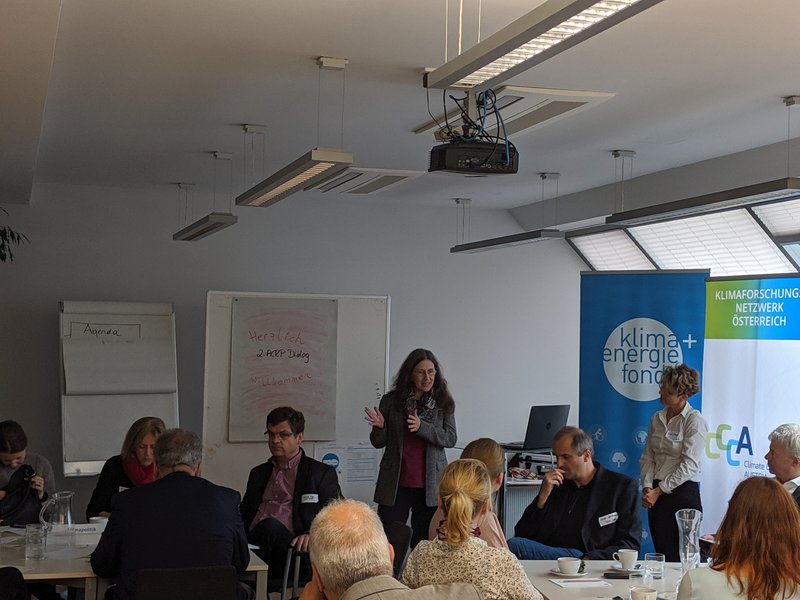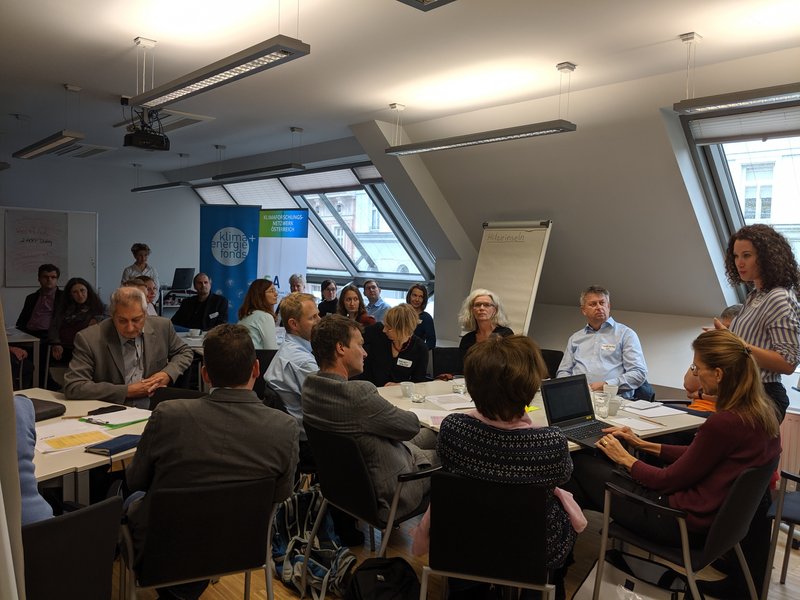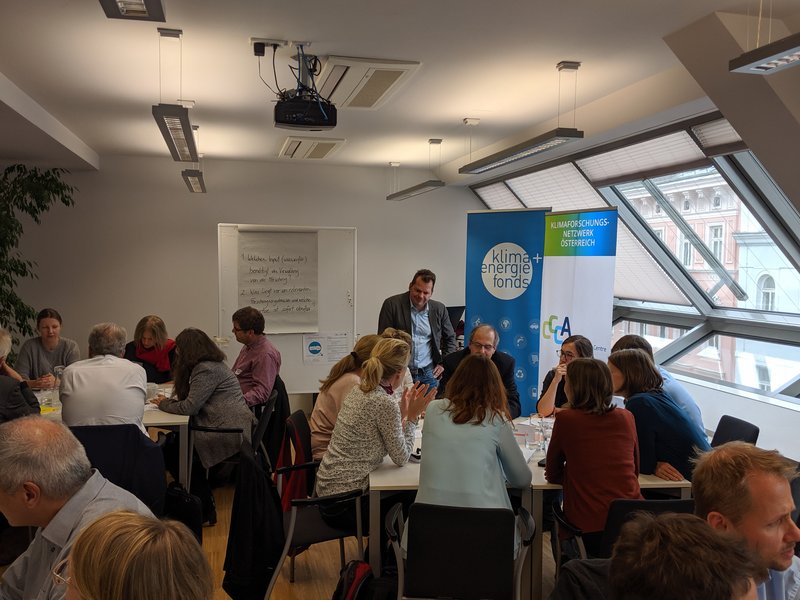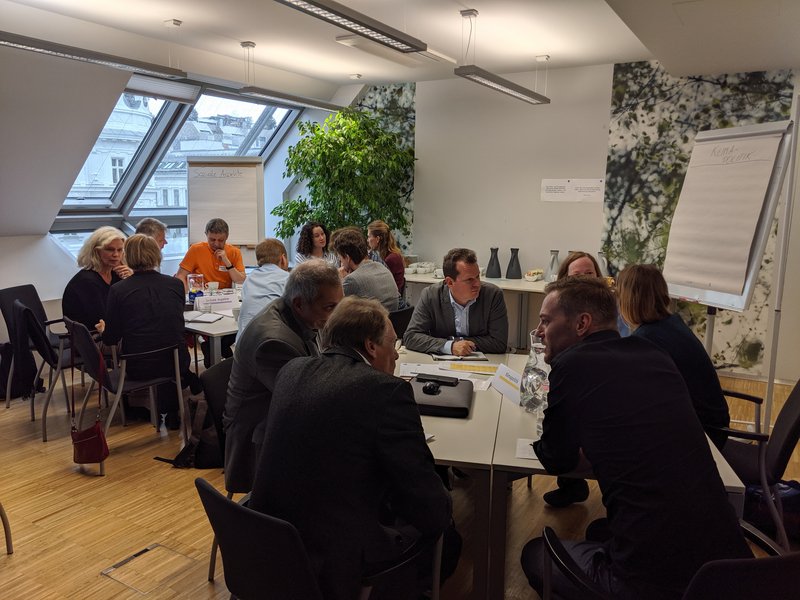


On 30 October 2019, the second informal workshop on the topic of "Social Aspects of Climate Change, Climate Policy and Heat Islands" took place.
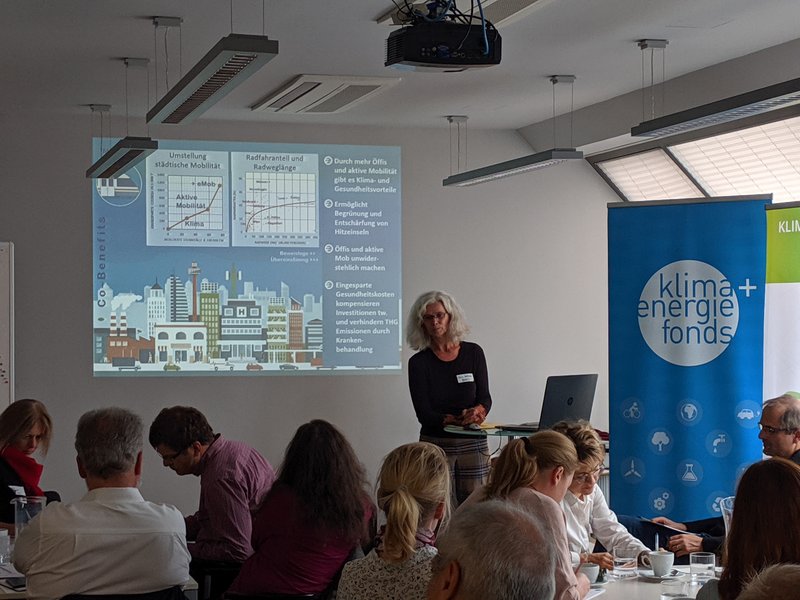
At the premises of the Climate and Energy Fund, around 30 participants from research and public administration came together to discuss the above-mentioned topic and exchange information. After brief welcoming remarks from DI Ingmar Höbarth (Climate and Energy Fund), Dr. Barbara Kronberger-Kießwetter (BMNT) and Dr. Isabella Uhl-Hädicke (CCCA Board, University of Salzburg), the dialogue kicked off with two short presentations from renowned researchers with relevant expertise. Dr. Ulli Weisz from the Institute of Social Ecology at the University of Natural Resources and Life Sciences gave an informative talk on "Social Aspects of Climate Change – Heat". This was followed by Prof. Daniel Barben from the Institute of Science, Technology and Society Studies at the University of Klagenfurt, who set the scene on "Social Aspects of Climate Policy".
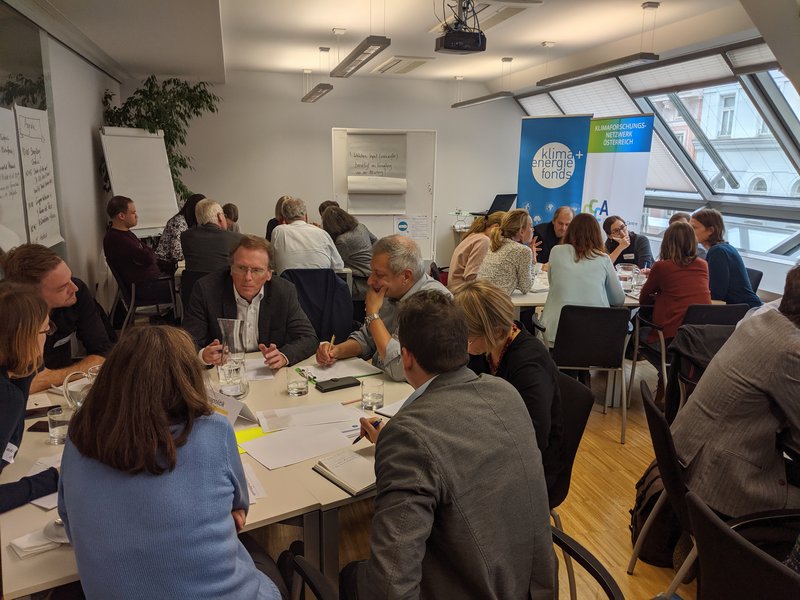
Participants then exchanged views on the topics of heat islands (incl. social aspects), social aspects of climate change, and social aspects of climate policy.
The following questions were discussed:
- On which topics and for what purposes does public administration need input from research?
- What relevant research findings already exist, and what expertise is already directly available?
- How can the existing findings be made useful for public administration?
Conclusions
Closing round and reflection – What would I like to continue working on?
Public administration:
- Emphasise social aspects within the ministry
- Integrate what was heard into working groups
- Review of climate-damaging subsidies at state level as well
- Increase exchange between the Chamber of Labour and CCCA
- Incorporate the social dimension into the climate check
- More targeted/concrete dialogue formats
Research:
- Present research findings in a well-prepared and accessible manner
- Stronger outward communication
- Present and disseminate existing material in an engaging way
- Convey knowledge in a way that leads to implementation
- Communicate knowledge even more effectively to administration, policy-makers and society
- Discussion within CCCA on the question "What can science afford to do?"
- Take into account the different time horizons of different groups
Translation work and networking:
- Focus on translating work from research to public administration (incl. insights on acceptance)
- Act even more as a translator for administration and policy-makers
- A format that brings both sides (note: administration and research) together despite time pressures (e.g. videos)
- Make use of CCCA services (Newsletter)
- Make use of the CCCA competence map
- Maintain contacts with individuals for workshops
- Create a structure that covers all actors involved in climate change and health
Further research needs:
- Focus on the "dark side" (losers, …)
- Research on time dimensions
- Research on social barriers in climate policy (viewing researchers as scientific citizens)
- Geoengineering as an important research topic
- Research on social impact
- Social partnership and climate policy