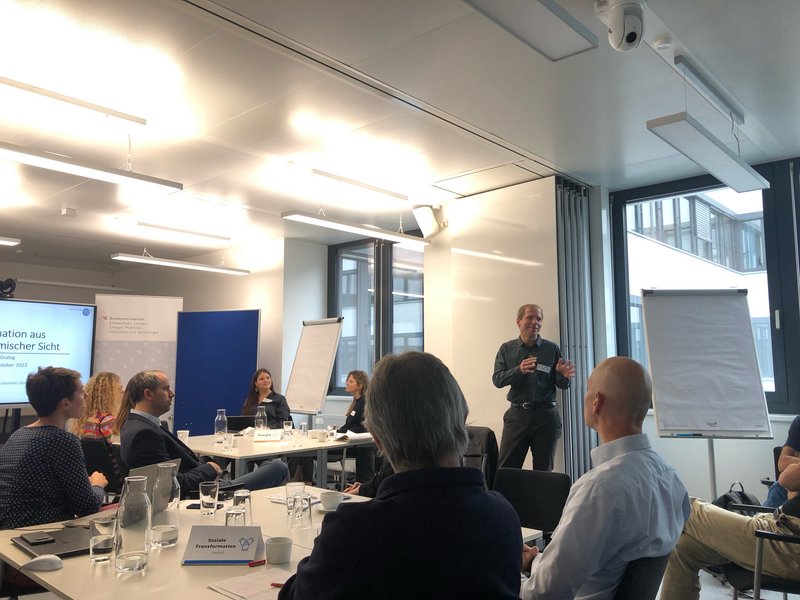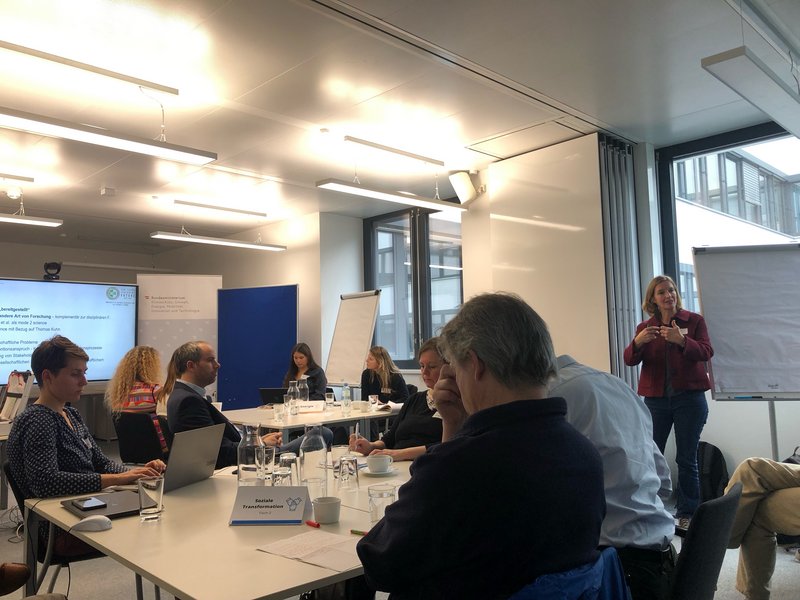


On 21.10.2022, the fourth ACRP Dialog took place on the topic of "Transformative Research".
Around 30 representatives from research and administration took part in the 4th ACRP Dialog to discuss the above-mentioned topic together and exchange information. Following brief welcome remarks from Gernot Wörther (Climate and Energy Fund), Marie-Christine Hopfgartner (BMK), Daniel Huppmann (CCCA Board, IIASA) and Karoline Augenstein (ACRP Steering Committee, University of Wuppertal), the dialog kicked off with two short presentations. Marianne Penker (BOKU) gave a brief introduction to the topic of transformative research. This was followed by Gustav Resch (TU Wien) shedding light on transformation from an energy systems perspective. During the break, participants had the opportunity to network and could learn more about the event's topic using the CCCA Fact Sheet on Transformative Research.
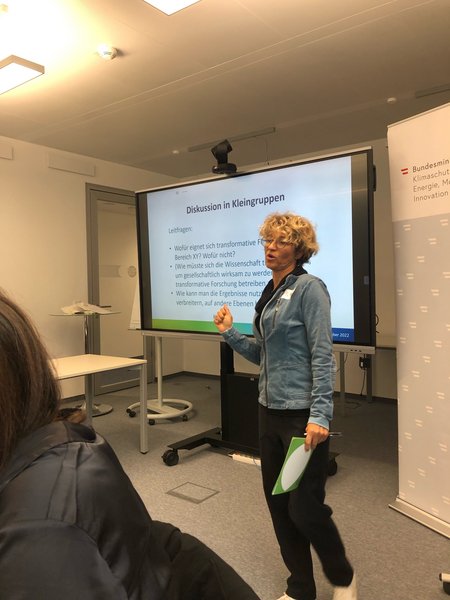
After the break, participants split into five different small groups for discussion and explored the topic of transformative research using a set of guiding questions.
To wrap up the event, all groups had the chance to briefly present their key findings in plenary:
Transformative research is well suited
- to identify barriers/problems/conflicts and/or to highlight potential solutions;
- to address socially relevant topics, including questions of distribution;
- to develop trans- and interdisciplinary understanding;
- to increase public acceptance;
- to promote societal dialogue.
- Transformative research must not be seen as competing with basic research. Both types of research are important and complement each other.
- For strong transformative research, the Third Mission must also be strengthened (both within universities and via BMBWF).
- Not only research, but also research funding, administration/policy, and political systems need to change in order to achieve large-scale transformations.
- In particular, existing power structures need to be broken down.
- Transformative research should involve all stakeholders and population groups (including vulnerable groups) —> stakeholders move from being objects to becoming subjects.
- Better communication is needed in future
- Between science and administration
- Between science and the public (including language!) —> This requires dedicated funding for science communicators
- Transformative research must be embedded in (formal) education (not just at university level) and through new, innovative formats (e.g. citizens' assemblies)
- Transformative research should be institutionally established to ensure continuity (e.g. in terms of staffing and funding).