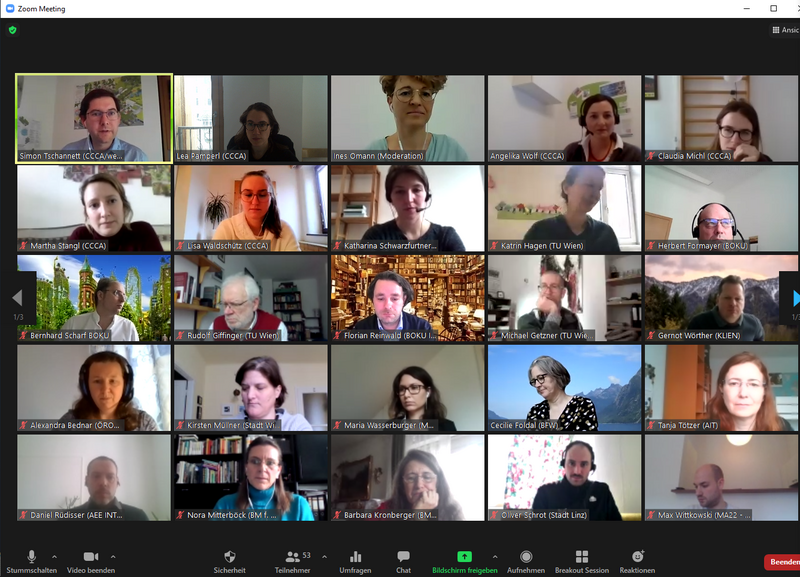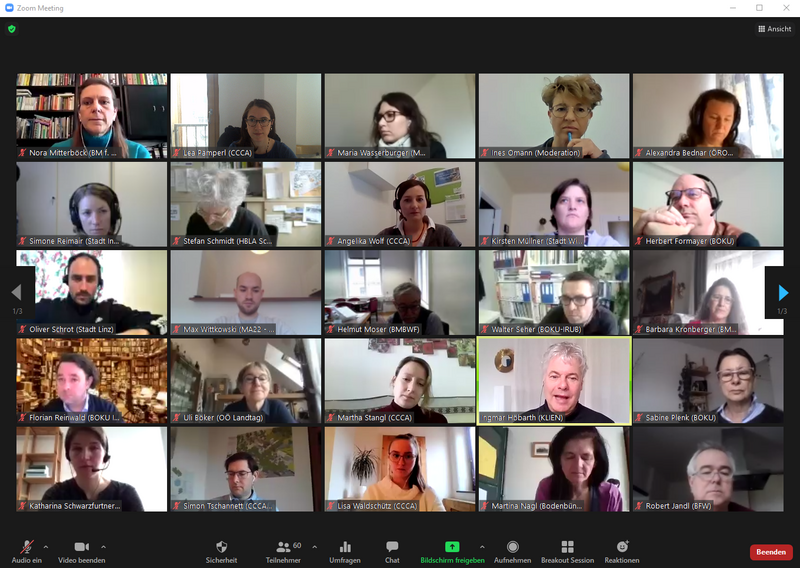


On 19.2.2021, the third informal workshop on the topic "Making built-up areas climate-fit! How must developed areas be designed so that they contribute to climate protection and climate change adaptation?" took place.
Due to the Covid-19 pandemic, the dialogue was held virtually via Zoom conference this time. Around 60 representatives from research and public administration took part to discuss the above-mentioned topic and exchange information. Following brief welcome remarks from DI Ingmar Höbarth (Climate and Energy Fund), DI Nora Mitterböck (BMK) and Mag. Simon Tschannett (CCCA Board, weatherpark GmbH), the dialogue kicked off with two short presentations from researchers with relevant expertise. Dr. Bernhard Scharf from the Institute of Engineering Biology and Landscape Architecture at the University of Natural Resources and Life Sciences gave an informative talk on the topic "The Soil–Water–Plant Interaction System". This was followed by Dr. Tanja Tötzer from the Center for Energy at the Austrian Institute of Technology, who set the scene on the topic "Planning Climate Resilience from Urban Region to Neighbourhood".
Participants then had the opportunity to exchange views and network in moderated small groups. The following questions were discussed:
- What challenges do you face in the area of soil sealing and climate change?
- What relevant research findings are already available, and what expertise can be directly accessed? On which topics and for what needs does public administration require input from research?
- What steps can be taken in the short term/long term? What is needed to do so?
Conclusions
Closing round and reflection – What would I like to continue working on? What are my wishes?
Public administration:
- Strengthen future-oriented initiatives from the public
- Trees in street spaces – placing them correctly – where?
- Raising awareness at municipal level
- Establishing and enforcing legal frameworks for climate change adaptation
- Improve the concrete implementation of measures! (There are already plenty of strategies and targets!)
- Integrated neighbourhood planning
- One tree for every new building project
- Political will: climate as a transformation issue by design, not disaster
- Developing projects for greening town squares
Science:
- Long-term availability and regular updates of data for researchers, decision-makers, and the interested public
- Research contribution on plant use in street open spaces
- Continued funding for relevant research projects in the future
- Better evaluation of projects that have already been implemented
- Surveying stakeholders in cities as well as scientific experts on the topic of resilience in urban and regional development
- Socio-economic impact assessment of climate change (costs, health impacts, comfort, etc.)
- Climate protection through soil conservation, soil management, recycling of organic material, and deep-rooting plants
- Interdisciplinary approaches as a prerequisite for urban climate assessments
Translation work and networking:
- Support for practitioners in finding appropriate expert groups
- Science-based communication accessible to a general audience
- Interdisciplinary knowledge exchange between all stakeholders
- Promoting exchange and fostering networking
- Better coordination and networking between the various decision-makers
- Better preparation of scientific foundations, and initiating greater cooperation and exchange with decision-makers regarding implementation