



Reinhard Mechler (IIASA) und Sarah Louise Nash (BOKU)
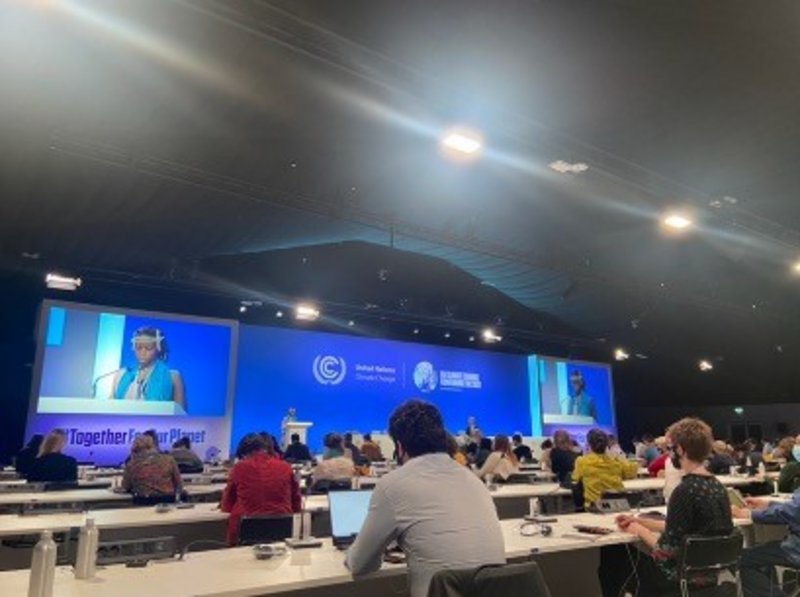
Despite COVID-related restrictions and limited access for some participants, the 26th climate conference brought thousands of negotiators from the Global North and South, a strongly represented civil society, international institutions, the private sector, and the research community to Glasgow — though the strong presence of the fossil fuel industry was heavily criticised. Following the cancellation in 2020, the hybrid physical and virtual meeting was the first climate conference at which rules under the 2015 Paris Agreement replaced obligations under the Kyoto Protocol.
The aim of the Paris Agreement is to limit the global temperature rise to ideally +1.5°C, but no more than +2°C (compared to pre-industrial levels), to ensure appropriate climate change adaptation and climate impact management measures, and to generate financial resources that are intended to benefit particularly vulnerable states and communities.
The conference was an important test of whether the cooperation agreed under the Paris Agreement can function in a complex world hit hard by COVID, a world that has already warmed by +1.1°C and is clearly feeling the effects of climate change. The two weeks of intensive exchange and the agreed final accord (the Glasgow Climate Pact) show that the Paris Agreement is having an impact, that the need to limit global warming to +1.5°C is clear to all participants and Paris signatory states — but that implementation remains inadequate and must be significantly strengthened, with the help of evidence-based science.
What was achieved?
Rhetorically, the Glasgow meeting was a clear success. In negotiations, workshops, and informal exchanges, there was broad consensus that the climate crisis is increasingly taking on an existential character, that transformations in climate protection and climate change adaptation are necessary, and that solidarity and climate justice must be central principles in the fight against climate change. The phase-out of fossil fuels was also mentioned explicitly in a final document for the very first time.
Awareness of the need to achieve the +1.5°C target is high, as confirmed in three paragraphs of the final document. Climate-related events in recent months, along with scientific reports from the Intergovernmental Panel on Climate Change (IPCC) and the APCC, have shown that the impacts of climate change are already associated with massive consequences for life and limb; and that beyond +1.5°C, incalculable and existential risks loom — such as a sharp increase in heatwaves, further sea level rise, the spread of droughts, and the loss of unique oceanic and terrestrial ecosystems.
Greenhouse gas mitigation — the first impact of the Paris Agreement
The Paris Agreement commits its signatories to submit national greenhouse gas reduction targets and climate change adaptation targets every five years through Nationally Determined Contributions (NDCs), following a specific logic. Signatory states prepare NDCs, which are peer-reviewed by other states in the spirit of the Paris Agreement with regard to the necessary national ambition and the collective achievement of the +1.5°C target; the targets are then to be tightened over successive reporting periods. This reporting process is mandatory with clear rules, however Paris does not provide for binding targets. As a result, a great deal depends on building trust and cooperation.
All signatory states have in fact submitted NDCs to date. Targets were sharpened further in the run-up to and during the negotiations in Glasgow: for example, India promised for the first time to achieve net-zero emissions — by 2070. Since climate protection and climate change adaptation are also always global tasks, major global initiatives were launched in Scotland to protect forests and reduce methane emissions.
The Paris Agreement appears to be having an effect, yet the promised reductions (pledges) are far from sufficient and are fraught with considerable uncertainty. According to estimates from the Climate Action Tracker, implementation of the current NDC plans would result in global warming of approximately +2.4°C (range of +1.9°C to +3.0°C) by 2100, compared to an estimated warming of approximately +2.7°C (2.2°C to 3.4°C) with current measures. However, these projections are highly uncertain, as they assume full implementation of all proposed measures and concrete plans for the time horizon beyond 2030 are largely absent. Various studies also project considerably higher rates of warming.
Adaptation to climate impacts and risks moves to the fore
In the context of the worsening climate crisis, climate impacts, risks, and climate change adaptation were strongly in the foreground in Glasgow, further reinforced by numerous actions by civil society inside and outside the conference centre, which compellingly highlighted current and future impacts.
Civil society action in Glasgow
The role of climate change adaptation was strengthened, both in terms of objectives and support for vulnerable states in the Global South. A doubling of Adaptation Fund resources was agreed, and the previously missed target of $100 billion in annual financing for climate protection and climate change adaptation for non-industrialised countries was reaffirmed. Plans were coordinated to deliver the promised sums for the period 2020–2025, with the commitments comprising a mix of additional resources for climate protection and climate change adaptation, loans, and redirected development cooperation funds. A process was also agreed for long-term financing of climate change adaptation measures from 2025 onwards.
Beyond the limits of adaptation
However, it is clear that climate change adaptation cannot fully reduce climate risks and that limits to adaptation exist. In Glasgow, questions about how to deal with impacts that have already occurred and those yet to come — negotiated under the heading of Loss & Damage (climate-related losses and damages) — were discussed in a confrontational manner between states from the Global North and South. The G77+China bloc and civil society have been vehemently demanding additional funds to address climate-related impacts for several years. While the Global South called clearly in Glasgow for an institutional foundation and a fund for financial support and compensation for damages, the Global North was only willing to continue the dialogue. Agreement was reached, however, on next steps for technical cooperation through a newly established network institution (the Santiago Network for Loss & Damage).
The topic gained momentum in Glasgow after Scotland's First Minister Nicola Sturgeon put £1 million in financing for such climate-related damages on the table at the start of negotiations, later increasing this amount to £2 million by the end, whereupon the Belgian region of Wallonia and an international consortium of philanthropists added €4 million near the close of the meeting. These financial commitments, though largely symbolic in nature, were partly made for the first time by state actors in industrialised countries and may help to bring further movement to a complex area of negotiation.
Strengthening science to boost ambition further
The role of science was very clearly reaffirmed after years of organised doubt about climate change and its impacts, orchestrated by a small number of but influential states. The first chapter of the Glasgow declaration reinforces the central role of science in identifying the risks and impacts of climate change, possible mitigation strategies, as well as measures to prevent and manage the necessary climate change adaptation. As the consensus document of approximately 200 negotiating states goes on to state, this applies in particular to the coming years and the 'critical' decade of the 2020s, in which the +1.5°C target must be achieved through knowledge-based transformation pathways, and climate change adaptation and risk management strategies must be implemented. IPCC climate reports on risks and climate change adaptation in February 2022, as well as on mitigation in March, will serve as important foundations for further negotiations in 2022 and beyond.
Austria as a negotiating party was quite active as a member of the EU negotiating bloc and also led the EU's difficult negotiations on emissions trading under the Paris rulebook. Important progress was made in the negotiations, although some potential loopholes could not be completely closed. After initial hesitation due to questions about the role of nuclear power in climate protection (as rejected by Austria), Austria also engaged as part of the so-called High Ambition Coalition, which was founded by the Marshall Islands and encompasses countries from both the Global North and South.
To-dos for Austria
As a signatory to the High Ambition Coalition in Glasgow, Austria must now also take on an effective pioneering role internationally in the areas of climate protection, climate change adaptation, and the management of climate impacts. This means making every effort once again to keep to the +1.5°C limit. The responsibility of G20 states, which together could limit global warming to +1.7°C by 2100, is also highlighted. This should also build international pressure to tighten NDCs ahead of COP27. Of particular relevance to Austria are, among other things, the agreed efforts to phase out inefficient subsidies for fossil fuels as quickly as possible — though what signatories mean by this remains open (with the exception of coal production). In addition, methane emissions are to be reduced by at least 30% by 2030 compared to 2020 levels, and emission reductions in the transport sector are also underpinned in the consensus document. Furthermore, financing for vulnerable states should be increased and these states should be given backing in difficult negotiations. As a high-emissions country, Austria must now actively face its responsibility in tackling the climate crisis and rapidly put further effective measures in place. Some progress was made in recent weeks with CO2 pricing and the Klimaticket, but that is not enough for the High Ambition Coalition. It is now necessary to renew as quickly as possible the Climate Protection Act that expired in 2020, embedding concrete "roadmaps" for a reversal of the trend in climate protection.
Final showdown
Climate negotiations typically end with the adoption of a consensus agreement by the plenary of member states, which sets out important agreements and intentions and looks to the future. The closing plenary in Glasgow, as in many previous years, turned into a showdown. Although dissatisfied with many points (climate protection, financing, handling of climate-related losses and damages), the states of the Global South were willing to accept the final document in order to save the package built around the +1.5°C target. Much trust was then destroyed — particularly among affected island states and representatives from Africa and South America — when the major emitters India and China forced, in a last-minute backroom deal, a watering down of the coal phase-out, with the groundbreaking formulation of the necessary global exit from coal energy (phasing out) reduced to the vague gradual step towards an exit (phasing down). A minimal adjustment in wording with potentially maximum consequences for the 1.5°C target; currently there are 4,000 coal-fired power plants in operation worldwide, a large proportion of which would need to be closed according to calculations in order to give the +1.5°C climate target a reasonable chance.
What remains?
Overall, another important, if insufficient, international step was taken in Glasgow towards addressing the climate crisis. Ultimately, however, disappointment prevailed among (almost) all negotiators over the inadequate outcome on climate protection, climate change adaptation, and the management of impacts. Although, as proposed by some countries, the word 'emergency' was not included in the title of the Glasgow Climate Pact final document, the climate crisis was omnipresent inside and outside the conference halls. It is therefore necessary to continue strengthening ambitions and to sharpen the NDCs, which are to be submitted and evaluated in 2022.
Because: the turning of the tide is still some way off. According to initial estimates, global greenhouse gas emissions rose sharply again in 2021, after falling in 2020 for the very first time since records began — a decline driven by COVID. Globally, and in Austria too, there is a great deal to be done to reduce emissions and strengthen climate change adaptation measures, as well as to support particularly affected states and communities. The work of negotiators and other actors will continue after the conclusion of negotiations in Glasgow through further meetings, negotiations, and actions, and will need to ensure that the +1.5°C target remains in sight and that efforts towards greenhouse gas mitigation, climate change adaptation, and the management of climate impacts are massively scaled up.