

18 June 2015

English
CCCA-News 2/2015
CCCA-News No. 2/2015
Dear CCCA-News subscriber,
in this second CCCA-News of 2015, we're filling you in on the newly elected board and reporting on the 16th Austrian Climate Day.
Also in this newsletter:
- Info on our literature database
- New Fact Sheets
- WMO updates climate normal period to 1981–2010
- JPI Climate adopts open-access guidelines
- ACRP - Austrian Climate Research Programme 8th Call for Proposals 2015
- Energy Research Programme 2015
- Eduard Richter Prize
- Latest calendar entries
We hope you enjoy reading through the articles!
General Assembly and election of a new CCCA board
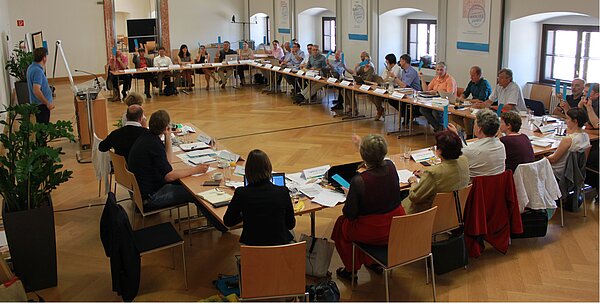
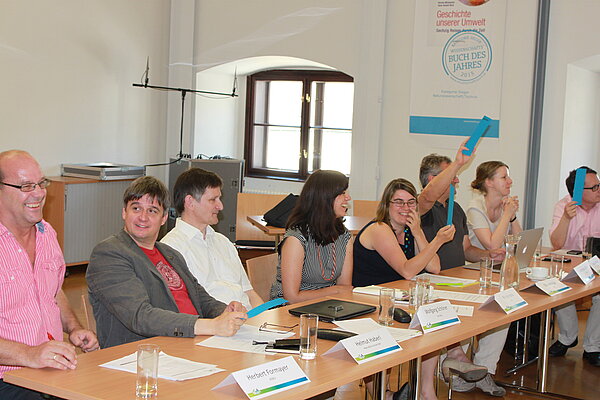
At the 7th ordinary General Assembly of CCCA, held on 3 June 2015, a new board was elected for the next two years. Around newly appointed CCCA chair Wolfgang Schöner (University of Graz), a team of representatives from both university and non-university CCCA member organisations came together to succeed the founding board after four successful years in office.
Like the founding board before it, the new CCCA board reflects the diversity of research disciplines represented within CCCA.
Wolfgang Schöner (Chair) Uni Graz
Angela Michiko Hama (Deputy Chair) alpS
Herbert Formayer (Deputy Chair) BOKU
Helmut Haberl (Deputy Chair) AAU
Andreas Richter (Secretary) Uni Wien
Elisabeth Rigler (Deputy Secretary) UBA
Claudia Kettner (Treasurer) WIFO
Gerhard Wotawa (Deputy Treasurer) ZAMG
CCCA and its staff team would like to extend a heartfelt thank you to the founding board (Hans Stötter, Helga Kromp-Kolb, Michael Staudinger, Karl Steininger, Angela Köppl, Sabine McCallum, Franz Prettenthaler, Josef Hochgerner & Nebojsa Nakicenovic) for their constructive and successful work over the past years, and looks forward to a great collaboration with the new board team!
"When Knowledge Meets Foresight" — That was the 16th Austrian Climate Day
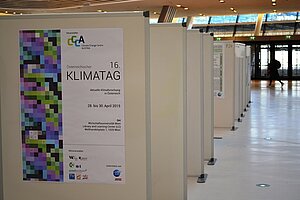
At the invitation of the Climate Change Centre Austria (CCCA) and in cooperation with WU, AAU, BOKU, alpS, the Environment Agency Austria, TU Wien, ZAMG and the City of Vienna, this year's Austrian Climate Day took place once again in Vienna.
The congress of the Austrian climate research community attracted over 300 experts, early-career researchers and a broad interested public to the Library & Learning Center of the Vienna University of Economics and Business, designed by star architect Zaha Hadid, to exchange ideas on climate change, climate protection, and measures against and strategies for climate change adaptation.
In numerous scientific sessions, colleagues and participants discussed questions around this pressing topic, which was presented across 48 talks and 31 posters. The scientific talks and posters are available for download on the CCCA homepage.
Alongside the scientific exchange, dialogue with society was also a key priority.
For the second time, two school classes (HTL Spengergasse & BRG Schopenhauerstraße from Vienna) had the opportunity to engage directly with scientists as part of the "Dialogue between Science & Schools" and discuss their questions about climate change. Under the patronage of the City of Vienna, multipliers (such as teachers, educators and environmental advisers) from a wide range of social sectors were invited for the first time to exchange ideas with scientists in workshops and explore effective, audience-appropriate ways of communicating the topic of climate change.
In the early-career researchers' session initiated by CCCA, Austria's ambitious young researchers were given the opportunity to connect with one another and build future-oriented networks.
The CCCA Early-Career Prize went to Philipp Babcicky and Sebastian Seebauer (both University of Graz), for their scientific paper entitled "The impact of Social Capital on Flood Risk Perception and Response Capacity of private Households". The 16th Austrian Climate Day drew to a close with the awards for the three best scientific posters: "Decreasing greenhouse gas emissions of meat products through food waste reduction - Framework for a sustainability impact assessment approach", Ralf Aschemann, Thomas Winkler (1st place); "Modelling impacts of second generation bioenergy production on Ecosystem Services under climate change scenarios in Austria", Dagmar Henner, Pete Smith, Christian Davies, Niall McNamara (2nd place); "Vom Zuschauen zum Anpacken - neue Wege in der Klimakommunikation an Jugendliche", Sybille Chiari, Silvia Mandl, Sonja Völler (3rd place).
A list of all poster contributions can be found here.
With this event, the Climate Change Centre Austria has taken another important step towards connecting climate research with policy, media and the public.
Next year, this successful event will continue in the form of the 17th Austrian Climate Day, taking place in early April in Graz.
Literature Database
In the Austrian assessment report on climate change 2014 (AAR14), alongside internationally published specialist journal articles, greater use was also made of grey literature — though (as with the IPCC) only on the condition that it is, or has been made, accessible. This was felt to be necessary to a greater extent at the national level, because studies on local and regional issues are often not published in peer-reviewed journals, yet can still make a significant contribution to the state of knowledge on climate change in Austria.
As a by-product of AAR14, what has emerged is not only a literature database containing all the references cited in the report, but also a collection of grey literature made accessible through the Climate Change Centre Austria (CCCA) and continuing to be maintained. The database currently holds over 3,500 literature references from over 8,000 authors.
Click here to access our literature database!
New Fact Sheets
With its Fact Sheets, the CCCA provides climate-relevant fundamentals as well as current research findings, in the form of brief summaries to both interested laypeople and experts alike.
The two latest Fact Sheets on the topics of "Regional Climate Modelling in Austria" and "Tourism" are available here as a pdf download.
WMO updates climate normal period to 1981-2010
New Two-Tier approach on "climate normals" News 1 June 2015
Congress recognizes urgent need to incorporate climate change in decision making
The World Meteorological Organization will introduce a new a two-tier approach to the 30-year baselines for climate data to take into account the rapid pace of climate change as well as the operational needs for up to date climate information. Because the climate varies naturally from year to year, climatologists use standard 30-year averages of temperatures, precipitation and other variables to put, for example, the magnitude of a current heatwave or rainstorm into historical context.
These 30-year historical averages are called "climate normals" and can be calculated at the local, national or global levels. Climate normals are presently updated once every 30 years, and the current official climate normal period is 1961-1990. The resulting averaged data are called WMO Climatological Standard Normals. However, rising atmospheric concentrations of greenhouse gases are changing the Earth's climate much faster than before.
As a result, decision-makers in climate-sensitive sectors and industries such as water management, energy, agriculture and viticulture may be basing important decisions on information that may be out of date. The World Meteorological Congress, WMO's top decision-making body on Standards, approved a resolution that WMO will update the climatological Standard Normals for operational purposes every 10 years and will use 1981-2010 as the current base period.
More informations: www.wmo.int
JPI Climate adopts Open Access guidelines
The European research funding network "JPI Climate" is actively engaged with the topic of "transparent climate research". In May 2015, the "JPI Climate Guidelines on Open Knowledge" were officially adopted by the JPI Climate governing board.
These guidelines are not only a useful resource for research funders, but also for researchers and decision-makers dealing with the management, accessibility and transparency of research data and findings. Topics such as Data Management Plans, various types of data storage, licensing and publications are covered, for example. The guidelines will shortly be available on www.jpi-climate.eu in two versions (standard and short version).
ACRP - Austrian Climate Research Programme 8th Call for Proposals 2015

The sixth call of ACRP is open, and projects can be submitted online until 3 September 2015.
Details can be found at: https://www.klimafonds.gv.at/foerderungen/aktuelle-foerderungen/2015/austrian-climate-research-programme-2/http://www.startclim.at/index.php?id=115
Energy Research Programme 2015
The Climate and Energy Fund is pleased to announce the launch of the Energy Research Programme 2015. The call is endowed with 30 million euros for the submission of innovative energy and mobility research projects.
All call documents can be found on our homepage.
Call for entries: Eduard Richter Prize
The Association Glacier and Climate promotes scientific research in mountain regions across the disciplines of hydrology, biology, glaciology, meteorology and geophysics, including all related fields. To support early-career researchers, a prize is being offered for an outstanding thesis or scientific publication completed at an Austrian research institution in 2013 or 2014.
The call for entries and further information can be found here.
Latest entries in the calendar
Symposium on Regional floods: Effects of changes in the river system
Vienna
13 to 14 October 2015
10th German Climate Conference
Hamburg
21 to 24 September 2015
1st Central European Polar Meeting
Vienna
10 to 13 November 2015
In the CCCA calendar you'll find plenty more information on climate (research)-related events. If you'd like to publicise events this way, please send the relevant details to info@ccca.ac.at.
| Current and previous newsletters as well as the sign-up form for the newsletter can be found at <link de service newsletter>www.ccca.ac.at/de/service/newsletter/ . | ||||||
| ||||||
If you have any questions about this newsletter or about CCCA and its facilities, feel free to get in touch with the CCCA team at any time: | ||||||
CCCA Service Centre (Graz): servicezentrum@ccca.ac.at, 0316 873 9364 CCCA Office (Vienna): info@ccca.ac.at, 01 47654 7707 CCCA Data Centre (Vienna): datenzentrum@ccca.ac.at, 01 36026 2519 | ||||||
| Imprint Climate Change Centre Austria (CCCA) Climate Research Network Austria ZVR: 664173679 Borkowskigasse 4/4, A-1190 Vienna Tel: 01/47654/7707 mailto: info@ccca.ac.at www.ccca.ac.at | ||||||